
call_end

    • chevron_right

      Supreme Court: Can ISPs Be Liable For Piracy By Doing Nothing?

      news.movim.eu / TorrentFreak • 2 December • 6 minutes

    supremecourt The Supreme Court case between several major record labels and Internet provider Cox Communications is one of the landmark copyright battles of this decade.

    The outcome will determine how Internet providers should deal with pirating subscribers on their networks.

    The Supreme Court must decide whether an ISP can be held liable for failing to disconnect repeat copyright infringers. In addition, it must determine if this ‘inaction’ amounts to willful copyright infringement, even if the ISP wasn’t aware that its specific conduct was illegal.

    Supreme Court Hearing

    Yesterday, the Supreme Court heard oral arguments in the case, grappling with these questions for nearly two hours. The justices critically questioned all sides in their effort to form a final opinion.

    Cox’s attorney, E. Joshua Rosenkranz, began by arguing that it would be a dangerous expansion of the law to hold an ISP liable for the actions of its subscribers.

    He argued that under the “purpose” standard, liability should only apply if an Internet provider takes “affirmative steps” to facilitate copyright infringement. For example, by advertising piracy services.

    #b0b0b0;padding:15px;margin:20px 0;font-family:sans-serif;font-size:0.9em;color:#333;">

    Cox Communications’ key arguments

    • The “Purpose” Standard: Liability requires proof of “affirmative intent” to foster piracy (e.g., advertising illegal uses), not just knowledge that it is happening.
    • Passive Utility: An ISP shouldn’t be liable for “passive non-feasance” (doing nothing). Treating them as “Internet Police” would force them to disconnect innocent users, including schools and hospitals, to avoid risk.
    • The “Twitter” Defense: Relies on the Supreme Court’s Twitter v. Taamneh ruling, arguing that providing general services to bad actors isn’t aiding and abetting.

    Rosenkranz added that, under the record labels’ theory, Cox would be liable for failing to take action against alleged crimes. That would essentially turn ISPs into the “Internet police” with devastating consequences.

    “[T]he consequences of Plaintiffs’ position are cataclysmic,” Rosenkranz said, noting that universities, hospitals, and entire towns would risk being disconnected from the Internet.

    “Turning Internet providers into Internet police for all torts perpetrated on the Internet will wreak havoc with the essential medium through which [the] modern public engages in commerce and speech,” Rosenkranz added.

    The “Gun Dealer” Analogy

    At the hearing, several justices seemed skeptical of Cox’s claim that inaction is fine. Justice Sonia Sotomayor was particularly aggressive, stressing that Cox could know exactly which subscriber accounts were infringing but simply opts to do nothing.

    To illustrate her point, Justice Sotomayor challenged Rosenkranz with a vivid analogy.

    “If I’m a gun dealer and I’m selling to someone who says to me, ‘I’m going to kill my wife with this gun,’ I think the common law would say you knew what he was going to do with the gun; you joined in. Why isn’t your continuing to provide Internet service the same?”

    Cox’s attorney responded by noting that, unlike a murder weapon, an internet connection has substantial legal uses. However, the challenges were not over yet.

    Justice Ketanji Brown Jackson continued to test Cox’s theory that “inaction” does not create liability. She presented an even more extreme hypothetical scenario featuring an addicted infringer.

    “Suppose I come to you and I want to buy your services. I tell you that I as a customer am addicted to infringing on the Internet. I’ve been sued before. I know what I’m doing is illegal, but I just keep doing it. And not only that, Cox, based on where I live, is my only option.”

    Rosenkranz replied that even in that extreme scenario, selling internet access would not create liability for Cox, adding that the music companies or other rightsholders could sue this hypothetical piracy addict instead.

    The “Meaningless” Safe Harbor

    Representing the record labels, attorney Paul Clement stressed that Cox was not an innocent bystander but a “willfully blind” party that profited from piracy. He pointed to Cox’s internal communication, in which employees expressed contempt for the law, including a now-infamous “f*** the DMCA” email.

    The attorney, backed by Justice Kagan, argued that Cox’s legal theory is fatally flawed. If an ISP can never be liable without taking affirmative steps to encourage piracy, then the DMCA’s “safe harbor” would be unnecessary.

    “Why would anybody care about getting into the safe harbor if there’s no liability in the first place?” Justice Kagan asked. And after follow-up questioning, Cox’s attorney agreed that the safe harbor is not doing anything under their suggested liability rule.

    #b0b0b0;padding:15px;margin:20px 0;font-family:sans-serif;font-size:0.9em;color:#333;">

    The Record Labels’ key arguments

    • Willful Blindness: Cox isn’t neutral; it knew specific subscribers were “habitual abusers” and continued profiting from them.
    • The Safe Harbor Paradox: If ISPs are never liable without affirmative intent, the DMCA’s “Safe Harbor” (which protects ISPs only if they terminate repeat infringers) would be legally meaningless.
    • Material Contribution: Providing the essential means (internet access) to a known infringer with “substantial certainty” of future infringement constitutes liability.

    “Mass Evictions” & “BitTorrent Throttling”

    While Cox was grilled on the ‘inaction’ vs. ‘intent’ issue, the record labels faced tough questions over the requested Internet disconnections. Justices Alito and Gorsuch appeared concerned that the record labels’ liability standard would force ISPs to disconnect thousands of innocent people.

    Justice Alito specifically asked attorney Clement how an ISP is supposed to respond to repeated piracy notices if their customer is a university with 50,000 students.

    Clement argued that ISPs and rights holders could simply “have a conversation” to resolve such issues, a suggestion Cox’s attorney later dismissed as a “terrible answer” for a company facing “crushing liabilities”.

    Since it is impractical for a university to be disconnected from the Internet, or for a university to disconnect thousands of students, the record labels’ attorney suggested that bandwidth throttling could also be a viable anti-piracy measure.

    “I don’t think it would be the end of the world if universities provided service at a speed that was sufficient for most other purposes but didn’t allow the students to take full advantage of BitTorrent. I could live in that world,” Clement answered.

    U.S. Government Backs Cox

    The U.S. Government appeared as an amicus curiae and largely supported Cox’s legal interpretation. Deputy Solicitor General Malcolm Stewart urged the Court to adopt a strict “purpose” requirement, arguing that unless an ISP provides “targeted assistance” specifically to pirates, it shouldn’t be liable for the actions of subscribers.

    Stewart warned the Justices that expanding liability beyond this “purpose” test would be dangerous. He argued that forcing ISPs to disconnect allegedly pirating subscribers would clash with the essential role the internet plays in society.

    “The approach of terminating all access to the Internet based on infringement… seems extremely overbroad given the centrality of the Internet to modern life and given the First Amendment,” Stewart told the Court.

    #b0b0b0;padding:15px;margin:20px 0;font-family:sans-serif;font-size:0.9em;color:#333;">

    The U.S. Government’s key arguments

    • Supports Cox: Urges the Court to adopt a strict “purpose” requirement.
    • Limited Liability: Argues that unless an ISP provides “targeted assistance” specifically to pirates, it shouldn’t be liable for the general misuse of its network by the public.

    What’s Next?

    The Supreme Court now has to decide whether the $1 billion verdict will stand, or if the case will get a do-over at the lower court.

    If the court sides with the record labels, ISPs across the United States will continue to need strict “repeat infringer” termination policies to avoid legal liability. If Cox wins, rightsholders will have a hard time holding ISPs liable for pirating subscribers.

    The justices are expected to cast their preliminary votes in a private conference later this week, but a final written opinion is not expected before the summer of 2026.

    A copy of the oral arguments hearing transcript and the audio is available at the Supreme Court’s website .

    From: TF , for the latest news on copyright battles, piracy and more.

    • chevron_right

      Operation 404: 3,000+ Pirate Domains Blocked, USDOJ & USDOC Get to Watch

      news.movim.eu / TorrentFreak • 2 December • 4 minutes

    4040404 After years of uncontrolled piracy, in 2019 authorities in Brazil teamed up with ICE and the US Department of Justice to launch Operation 404.

    Described as a “milestone” for Brazil’s momentum in the fight against piracy, it was revealed that with assistance from overseas, 136 websites and 100 apps had been put out of action, either by domain suspension or site blocking measures.

    Local agencies and anti-piracy groups including ANCINE (National Film Agency) and the National Council for the Fight Against Piracy (CNCP), were pleased with their work, although it was far from done.

    Operation 404.1 Was Only the Beginning

    Named after the well-known HTTP error indicating a currently unavailable website, Operation 404 would need to build on its early momentum. To understand the scale of the challenge, one only has to look at one of the earliest targets, Futemax, which remains active today despite years of blocks.

    More domains would be needed to remain online

    For the past six years, authorities and rightsholders in Brazil have continued to add Futemax-branded domains to Brazil’s secretive blocklist.

    Whether Futemax, FutemaxHD, FutemaxBR or FutemaxTV variants, the domain-blocking Whac-A-Mole has seen commitment from both sides. At the time of writing, over 360 of these domains appear on the list, presumably at least some in connection with subsequent waves of Operation 404, which have generally taken place on an annual basis since 2019.

    Ministry of Justice Announces 404.8

    Brazil’s Ministry of Justice and Public Security (MJSP) announced that phase Operation 404.8 was ‘carried out’ November 27, without clarifying that only a relatively small number of events and achievements presented to the media actually took place on that day. This approach to presentation has persisted from 404.1 to the present day but the volume of work as reported only really makes sense as part of a longer timeline.

    In common with 404.5 (March 2023), 404.6 (November 2023) and 404.7 (September 2024), this year the Ministry reported an international effort in which local authorities collaborated with partners from Argentina, Ecuador, Paraguay, Peru, and the United Kingdom.

    Operation 404 (Phase 8) 404-8

    This was Ecuador’s first direct appearance within Operation 404 but for the United States government, which has provided significant support right from the very beginning, there was no direct involvement.

    The Ministry says that along with representatives from Mexico, the role of the U.S. Department of Justice and Department of Commerce was to observe, in order to “learn about the methodology used in combating digital piracy.”

    Much to Observe

    The MJSP said a total of 44 search and seizure warrants were executed, which includes four preventive arrest warrants and three arrests in flagrante delicto in various Brazilian states. The Ministry says the aim was to identify and hold accountable the operators and various individuals behind an unspecified number of “pirate platforms.”

    “Audio and video content, such as games and music, were removed,” the Ministry continued. “There was also the blocking and suspension of 535 websites and one illegal streaming application, in addition to the removal of thousands of pirated materials from repositories and social networks. In this phase, the focus broadened to reach the financing and monetization structures of these illegal services.”

    Operation 404.8 404-8-stat

    In common with previous phases, the Ministry reported collaboration with local federal agencies. They include the National Telecommunications Agency (Anatel) and the National Film Agency (Ancine), both of which are actively involved in having pirate websites blocked by local ISPs.

    That raises questions over Brazil’s broader site-blocking regime that receives very little attention.

    Operation 404 Blocking is a Fraction of Overall Blocking

    On face value, the number of pirate domains blocked under Operation 404 is publicly reported. Given tendencies seen in the past, that include conflating the number of sites blocked with the number of domains, the overall figures may or may not provide a reasonable account of events on the ground.

    Refusal to reveal exactly which platforms have been targeted are compounded by the secrecy surrounding Brazil’s primary blocklist, which is restricted and certainly not open for scrutiny. The same applies to the many orders handed down by judges that provide it with constant fuel.

    The table below covering Operation 404.1 to 404.8 inclusive, suggests that since 2019, just over 3,000 ‘pirate’ domains have been blocked on copyright grounds as part of Operation 404.

    Yet the country’s master blocklist currently contains over 30,000 entries. Since it also contains gambling site domains, the full list can’t be attributed purely to pirate sites.

    operation404-waves1-8

    Nevertheless, the number of sites/domains publicly declared as blocked is clearly just a drop in the ocean. Or, rather, it appears to be; for the last six years no domains have been mentioned in connection with Operation 404 blocking, which effectively rules out fact checking.

    Even access to the list of blocked domains is quickly of limited use. Without all-important context, it’s ultimately just a big list of domains.

    —————–

    Operation 404 receives cooperation from the following agencies, organizations, rightsholders, and anti-piracy partners:

    [UK] City of London Police – Police Intellectual Property Crime Unit (PIPCU)
    [UK] Intellectual Property Office (IPO),
    [USA] U.S. Department of Justice
    [USA] Department of Commerce
    [Peru] National Institute for the Defense of Competition and the Protection of Intellectual Property (INDECOPI)
    [UK] English Premier League
    [Spain] LaLiga
    [International] Alliance for Creativity and Entertainment (ACE)
    [Brazil] Brazilian Association of Pay Television (ABTA)
    [LATAM] Alliance against Audiovisual Piracy (ALIANZA)
    [Brazil] National Council to Combat Piracy (CNCP)
    [Brazil] Association for the Protection of Intellectual and Phonographic Rights (APDIF)
    [International] International Federation of the Phonographic Industry (IFPI)
    [International] Entertainment Software Association (ESA)
    [USA] Motion Picture Association (MPA)
    [Paraguay] National Directorate of Intellectual Property (DINAPI)
    [Japan] Content Overseas Distribution Association (CODA)
    [S.Korea] Copyright Overseas Promotion Association (COA)
    [Ecuador] National Intellectual Rights Service (SENDI)
    [Ecuador] National Police
    [Argentina] Specialized Fiscal Unit for Cybercrime Investigation (UFEIC)
    [Argentina] Federal Police of Argentina (PFA)
    [Paraguay] Specialized Unit for Punishable Acts Against Intellectual Property
    [EU] European Union Intellectual Property Office (EUIPO)

    From: TF , for the latest news on copyright battles, piracy and more.

    • chevron_right

      MPA Shut Down OnionPlay’s Discord & Tries to Unmask Pirate Site Operator

      news.movim.eu / TorrentFreak • 27 November • 4 minutes

    onionplay Founded in 2019, pirate streaming service aggregator OnionPlay has been around for half a decade already.

    While the site had to switch domain names occasionally, OnionPlay maintained its core identity while its user base continued to grow.

    Discord Deletes OnionPlay Channel

    At a time when pirate streaming sites are under heavy pressure from the MPA and its anti-piracy branch ACE, staying online can be quite a feat. This pressure also affected OnionPlay to some degree, as it suddenly lost its main Discord channel at the end of October.

    OnionPlay’s owner and operator, who uses the online handle “TexasHomie,” was told that the channel was shut down after copyright-infringing links were posted in violation of Discord’s rules.

    As a result, two years of community-building work disappeared overnight but TexasHomie didn’t throw in the towel. Inside two weeks, a new Discord channel was active.

    Back on November 12

    onion domain

    At the same time, OnionPlay traded in its .mx domain name for a new .bz variant. While business seemed to continue as usual, a new filing at federal court in California would soon reveal who was behind the Discord shutdown.

    MPA/ACE Demanded the Discord Shutdown

    On November 14, the Motion Picture Association (MPA) requested a DMCA subpoena on behalf of its member studio Warner Bros. These subpoenas can be signed off by a court clerk, provided that the requester has sent a DMCA notice to the intermediary involved.

    In this case, the MPA seeks information from Discord, and their legal request includes a copy of a DMCA notice in which ACE complains about links that were posted in OnionPlay’s old Discord channel.

    From the takedown notice

    takeodwn

    The DMCA notice was sent late October, shortly before the OnionPlay channel was taken down by Discord. As shown above, the email came with an exhibit mentioning “OnionPlay” by name and urged Discord to take the channel offline.

    “We request Discord’s assistance to (i) remove or otherwise disable access to the channels and servers identified above; and (ii) take steps to address Piracy Contents on the Discord platform,” the takedown notice, signed by MPA’s Larissa Knapp, informed Discord.

    Discord complied with the takedown notice, but that was not the end of the matter. With the recent DMCA subpoena, the movie industry group now hopes to unmask the owner and operator of the site.

    Discord Subpoenaed to Unmask TexasHomie

    The legal paperwork includes two examples of infringing links that were allegedly posted by a Discord user. One links to a pirated copy of the season 2 finale of “Peacemaker” and the other links to a pirated stream of the movie Weapons.

    Examples from the subpoena request

    dmca

    The MPA specifically requests Discord to identify the user behind ID ‘417142124228771850,’ which it had previously linked to “TexasHomie”.

    “Warner Bros. (via the Motion Picture Association, Inc.) is requesting issuance of the attached proposed subpoena that would order Discord, Inc. to disclose the identities, including the names, physical addresses, IP addresses, telephone numbers, and e-mail addresses, of the individual(s) that operate the Discord account with the following User ID: 417142124228771850”

    The request notes that information obtained through the subpoena will only be used to identify the alleged infringer so that Warner Bros. can protect its rights. This was sufficient for the court clerk, who signed off on the subpoena on November 17.

    The DMCA subpoena

    subpoena

    As shown above, Discord has until November 28 (tomorrow) to comply with the subpoena and hand over the information to the MPA.

    TexasHomie Remains Calm and Collected

    The DMCA subpoena is a useful tool for the MPA, but whether it will result in actionable information has yet to be seen. The MPA and ACE have tried to get information on OnionPlay’s operator before, with subpoenas targeting Cloudflare and the .to registry , presumably without effect.

    TexasHomie informs TorrentFreak that he was not aware that the MPA was behind the shutdown of the Discord channel. Nor has he been informed that Discord was asked to disclose his personal information.

    OnionPlay’s operator doesn’t appear to be particularly worried either and notes that he keeps his online and offline identities separate.

    “I’ve always operated behind VPNs, privacy layers, separate identities—the usual precautions when you spend enough years around the internet and IT infrastructure. It’s not about being shady; it’s about minimizing noise and keeping my real life cleanly separated from my online projects,” TexasHomie notes.

    “I’ve dealt with plenty of takedown notices and all the usual headaches, but when you work with the right hosting providers and understand how the infrastructure works, you learn how to manage things calmly and professionally.”

    TexasHomie takes pride in the fact that he has managed to keep OnionPlay going in a rather competitive streaming landscape. Community input is taken seriously, he notes, adding that OnionPlay is mainly an old-school “passion project” that requires quite a bit of manual work.

    Needless to say, this is a high-stakes passion project that can have criminal repercussions if the operator’s identity is unveiled. These are life-altering risks, making this Discord subpoena all the more important.

    A copy of the subpoena issued by the U.S. District Court for the Northern District of California on November 17 is available here (pdf)

    From: TF , for the latest news on copyright battles, piracy and more.

    • chevron_right

      Share-Online Operator Gets Two Years Probation in Landmark ‘Cyberlocker’ Verdict

      news.movim.eu / TorrentFreak • 26 November • 2 minutes

    share online logo In October 2019, an international police operation brought an abrupt end to Share-Online.biz, the largest file-hosting platform in Germany at the time.

    The raids , which targeted data centers in the Netherlands and France as well as residential addresses in Germany, resulted in the seizure of many servers and the shutdown of a platform that served more than a million registered users.

    Files stored on Share-Online were typically promoted through third-party sites such as DDL-Warez, Boerse, Movie-Blog, and MyGully. As a host/cyberlocker, Share-Online did not actively promote pirated content to the public.

    Suspended Prison Sentence for ‘Neutral’ Host

    That seemingly neutral stance did not prevent a criminal investigation or the subsequent prosecution of the site’s operator. This week, the Aachen Regional Court sentenced the defendant to a two-year suspended prison term.

    While the suspended sentence means the unnamed defendant will not serve prison time, the legal precedent is significant. Historically, cyberlockers have operated in somewhat of a legal gray area, claiming they are neutral service providers who merely offer storage space.

    The Aachen court rejected this defense, FAZ reports , concluding that the operator facilitated copyright infringement with a profit-motive.

    Seizure banner(2019)

    Details on the ruling are scarce, and we have yet to see a copy of the verdict. However, according to the Alliance for Creativity and Entertainment (ACE), which supported the anti-piracy action, it is a key victory.

    “This ruling makes clear that operators of ostensibly neutral platforms cannot rely on liability privileges or professed ignorance. For a platform like Share-Online, it is not sufficient to merely acknowledge abuse notifications from rights holders,” says Geerart Bourlon, MPA’s Vice President of Content Protection and Legal Counsel.

    “Anyone whose business model promotes or supports copyright-infringing acts is not only liable for injunctive relief and damages but also commits a criminal offense,” Bourlon adds.

    What Happened to the €50 Million?

    The MPA/ACE press release specifically credits Gregory Skavron, the prosecutor at the Nordrhein-Westfalen Cybercrime Unit ( ZAC NRW ). However, there is no mention of the now-bankrupt German anti-piracy outfit GVU, which carried out the investigation of Share-Online.

    Similarly, while the press release prominently features the €50 million revenue figure to illustrate the scale of the piracy operation, what happened to this money isn’t made clear. Were any of these funds actually recovered? And if so, were rightsholders compensated?

    The absence of any mention concerning damages suggests that, while the “revenue” was massive, the actual recoverable assets may have been much lower or hidden from law enforcement.

    The “User” Threat Evaporates

    Finally, it is worth mentioning that a spokesperson of the cybercrime police previously suggested that Share-Online users were also at risk, with high-volume uploaders as the prime target.

    “If identification is possible, subsequent investigations against the uploaders and possibly also against downloaders are realistic scenarios. For reasons of capacity, we will certainly proceed in a layered manner in the investigations and, in due course, may initially focus on the top uploaders,” the spokesperson said in 2020.

    This threat never materialized, as far as we know. This may be in part due to the complex investigation that spanned many terabytes of files. If it takes six years to convict the operator, going after uploaders may have turned out to be too much.

    Ultimately, the Share-Online outcome is somewhat of a mixed bag for rightsholders. The movie industry secured a major legal victory and defeated the “neutral host” defense. However, the fact that the site’s operator, who presumably earned millions, can avoid a prison sentence must be seen as a disappointment.

    From: TF , for the latest news on copyright battles, piracy and more.

    • chevron_right

      Greek Cybercrime Unit Shuts Down IPTV Pirates, 68 End Users Face Fines

      news.movim.eu / TorrentFreak • 26 November • 2 minutes

    A new legal framework to tackle online infringement in Greece went live just a couple of months ago, and reports of prosecutions are already coming in.

    Early September, it was reported that a man from Sparta faces prosecution and a fine of up to 6,000 euros for two IPTV piracy offenses.

    The suspect, reportedly a café owner, was targeted at his workplace on a Saturday, allegedly in front of customers. One told local media that they believed that complaints of the café engaging in “unfair competition” preceded the untimely visit.

    New Operation Much Larger in Scale

    The Cybercrime Prosecution Directorate launched their operation in the early hours of November 19. The Athens-based unit targeted a network that sold illicit access to premium pay-TV via IPTV subscriptions.

    The raid, conducted on Santorini, one of the Cyclades islands, resulted in the arrest of a 48-year-old, who, from police reports, appears to be a reseller for a larger network. Customers were reportedly charged €50 for 3 months subscription or €100 for 6 months. Sales and management were handled by the 48-year-old via an online platform known as a ‘panel’, while remote and in-person support were available as part of the service.

    The impact of the raid was visible on the islands, locals said. According to a local report , hundreds of users in hotels, cafes, and residences on Santorini and beyond, found themselves suddenly without access to cheap TV. Apparently few areas were untouched by the disruption, such was local reliance on illegal streams.

    Arrest and Seizure of Evidence

    The identity of the main suspect has not been released but as the focus of an early prominent case, facing charges of commercial exploitation of illegal IPTV subscriptions, the outcome is unlikely to be especially pleasant.

    During a search of the suspect’s home, police seized a modified IPTV device configured to illegally receive subscription channels from at least two unnamed companies, a laptop computer, a mobile phone, and €4,820 in cash. The seized digital evidence has been sent to the Criminal Investigations Directorate for laboratory analysis.

    End Users Face an Uncertain Wait

    The most significant tactical aspect of the operation may have been the choice of target and in particular, their customer base. If the reports are true, many may have operated from various commercial premises, such as hotels and cafes. This means they too could face significant fines of up to 5,000 euros, way above the 750 euro penalties reserved for individual users.

    Almost 70 targets is significant too, a number exceeded only in Italy, where people are fined by the state before their details are shared with DAZN and Serie A who request damages on top.

    From: TF , for the latest news on copyright battles, piracy and more.

    • chevron_right

      ‘Destroyed’ Usenet Provider NSE and BREIN End 16-Year Battle With Secret Settlement

      news.movim.eu / TorrentFreak • 25 November • 2 minutes

    shakehand The long-running legal battle between News-Service Europe ( NSE ) and anti-piracy group BREIN has quietly come to an end.

    NSE was once one of the largest Usenet providers, but its legal troubles started in 2009, when BREIN took legal action on behalf of the movie and music industries.

    In an early verdict in 2011, the Court of Amsterdam concluded that NSE willingly facilitated online piracy through its services. As a result, the company was ordered to remove all pirated content and filter future posts for possible copyright infringements.

    According to the Usenet provider, this filtering requirement would’ve been too costly to implement, so it shut down its service while it appealed the case.

    Supreme Court Win for NSE

    After several more years of litigation, the Amsterdam appeals court ruled that NSE wasn’t liable for users’ pirating activities after all, but NSE was required to offer a responsive and effective notice and takedown procedure, possibly with additional measures.

    Unhappy with the outcome, BREIN decided to take the matter to the Dutch Supreme Court. While NSE was no longer a threat, the case could prove crucial for many other Usenet providers.

    In 2023, the Supreme Court confirmed that the Usenet provider shouldn’t be held liable for pirating users. The fact that NSE had a decent takedown procedure and no apparent knowledge of infringement weighed in its favor.

    The Court also confirmed that NSE didn’t curate any content, nor did it specifically promote copyright infringement.

    NSE Seeks Millions in Damages

    The Supreme Court ordered BREIN to pay the legal costs. For NSE, however, the victory was bittersweet, as the company had already thrown in the towel well over a decade earlier.

    In a final effort to recoup some of its claimed losses, NSE sued BREIN for damages last December . Exact details were not revealed, but the claim could’ve easily reached millions of euros.

    While NSE shut down voluntarily, the company says that it saw no other option at the time due to BREIN’s legal pressure. As a result, the entire NSE team lost their jobs.

    In its initial response, BREIN looked forward to the new legal battle with confidence. BREIN director Bastiaan van Ramshorst said that NSE willingly decided to shut down its service in 2011, instead of engaging in court-mandated negotiations.

    NSE and BREIN Settle

    This latest lawsuit could’ve easily added a few more years to the legal battle. However, it won’t come to that, as NSE and BREIN have decided to settle their differences once and for all.

    Last Friday, the parties issued the same brief press release. This effectively confirms the end of the 16-year legal battle without adding any further detail.

    “Last week the parties reached a settlement, which allowed them to avoid further escalating litigation costs. Both sides are pleased with the outcome and have agreed not to disclose the details of the arrangement,” NSE and BREIN announced.

    The announcement

    nse brein

    This type of tight-lipped announcement suggests that the parties reached a compromise. Since NSE is a defunct entity with no operational future, financial compensation seems the only logical incentive for them to drop the multi-million euro claim.

    NSE had little to lose at this point, but, for BREIN, the settlement means that it no longer has to face a claim for ‘millions’ in damages. The details of this agreement will remain secret, which underscores that it remains a sensitive issue after all these years.

    From: TF , for the latest news on copyright battles, piracy and more.

    • chevron_right

      Live Sports Piracy: EU Commission Admits that Anti-Piracy Advice Had Limited Impact

      news.movim.eu / TorrentFreak • 24 November • 6 minutes

    swede-iptv1s For years, powerful rightsholders and media groups have demanded urgent and decisive action from the European Commission to tackle IPTV piracy of live sports and events.

    From the MPA, to the Premier League, Sky, LaLiga and Serie A, the message couldn’t have been clearer or more consistent. It didn’t change after the EC’s rejection of their call for urgent legislative measures in 2022, and remained intact following a consultation and advice early 2023 on a ‘toolbox’ of existing measures .

    EC Publishes Assessment of the Effects of Recommendation

    In May 2023, the European Commission (EC) issued a Recommendation aimed at tackling online piracy of sports and other live events. It encouraged measures concerning the processing of takedown notices, dynamic injunctions, cooperation between stakeholders, and increasing the availability of legal alternatives.

    Aiming to build upon existing legal frameworks such as the InfoSoc Directive, IPRED, and the Digital Services Act (DSA), it was detailed and comprehensive, without being especially urgent.

    Some two-and-a-half years later, an assessment of the effects of the Recommendation were published by the EC last week. The report evaluates the progress made by Member States, national authorities, and stakeholders in implementing the various measures outlined in May 2023. Monitoring was carried out by the EUIPO Observatory using Key Performance Indicators (KPIs) concerning piracy volume, processing of takedown notices, use of blocking injunctions, and availability of legal offers.

    Ensuring Prompt Execution of Takedown Notices

    Recommendation: Hosting services should process takedown notices sent by rightsholders as quickly as possible, to help protect vulnerable live events which have most of their value built into the event itself.

    Assessment: Only limited progress was reported. ‘Online platforms’ including social media, online marketplaces, and search engines, were generally more responsive due to their obligations under the DSA. Responses from other intermediaries such as Dedicated Server Providers (DSPs) and Content Delivery Networks (CDNs) were much slower, highlighting a significant gap in response times when compared to online platforms.

    Further Action: According to the report, there’s a need for increased cooperation with intermediaries, including working towards technical solutions to automate processing of takedown notices. The Commission says it will examine the role of intermediaries within the DSA Board discussions.

    Rightsholders’ Use of Blocking Injunctions in Member States

    Recommendation: Authorized under Article 8(3) of the InfoSoc Directive and Article 11 of IPRED, Members States should facilitate use of dynamic/live blocking injunctions, with appropriate safeguards, against infringers and intermediaries whose services are used to infringe copyrights.

    Assessment: The Commission notes that while injunctions are useful, implementation across Member States shows significant variation. At the extremes, some countries have very robust systems in place while others have no system at all. The Commission says there’s not only a need for much broader adoption across the EU, but also more consistent application.

    Further Recommendation on Injunctions: Member States are ‘encouraged’ to provide for injunctions against intermediaries, who, regardless of their lack of liability, offer services that are misused for illegal streaming of live sports.

    Assessment: Noting efforts in France and Belgium that have blocked CDNs , VPNs and DNS providers , and work in Italy to facilitate the same, the EC also highlights LaLiga’s work in Spain “ against ISPs and CDNs “. Under the DSA, some intermediaries may be exempted from liability, the EC adds, but the DSA does not preclude them from being blocked regardless.

    Since these are recent developments, “there is not yet sufficient data to assess the efficiency of dynamic injunctions addressed to those intermediaries,” the report concedes, adding that “a number of end-users, have complained about a few instances of over-blocking.”

    The Recommendation appears to have prompted some Member States to reassess their legal frameworks or engage in policy discussions to strengthen enforcement measures. Some Member States have clarified legal standing for sports event organizers, allowing them to pursue injunctions in their own right. Some rightsholders are demanding that blocking injunctions are recognized across borders.

    Discussions about the possible introduction of dynamic injunctions have been discussed in a few Member States, but not have not yet materialized. In others, there are no developments to report “prompting concerns” from certain stakeholders, the EC reports.

    Further action: The Commission will consider whether new measures are needed to ensure a wider and more consistent use of dynamic injunctions across Member States.

    Cooperation between Rightsholders and Intermediaries / Public Authorities

    Recommendation: Encourage cooperation between rightsholders and intermediaries to identify the source of unauthorized retransmissions and take measures to prevent repeat misuse.

    Assessment: Cooperation agreements to fight piracy exist across Member States, some concluded directly between the parties and others with assistance from public authorities. Agreements between rightsholders and ISPs on blocking measures and issues related to content blocking/removal appear to be most common.

    In 2024, participating rightsholders reported 49 voluntary cooperation agreements with intermediaries, rising to 62 in 2025. Cooperation with Dedicated Server Providers (DSPs) account for around two-thirds of agreements (42), with online platforms (18) quite a distance behind. Perhaps unsurprisingly, agreements to identify the source of infringement are far less common; just two were reported.

    In general, cooperation has improved, with voluntary agreements becoming more common. The majority of infringement notices resulting in suspension of access to infringing streams were issued in the context of cooperation agreements, with 55% of those proving successful. However, some rightsholders complained that most cooperation agreements still rely on manual processing of infringement notices, which limits effectiveness when applied to live sports.

    The Recommendation encourages Member States to actively engage in the exchange of information when sites and services are blocked as part of an injunction. Under the DSA, orders issued by authorities to act against illegal content must be shared by a Member State’s Digital Services Coordinator (DSC) with their counterparts in other Member States.

    This system is considered directly relevant to tackling piracy of live events but is not yet fully operational. However, the network is described as a “crucial initiative” through which valuable information is exchanged between participating authorities.

    Raising Awareness and Improving Availability of Legal Offers

    Recommendation: Increase users’ awareness of legal content, increase the availability, affordability, and attractiveness of live event commercial offers.

    Assessment: The report notes that submissions focused solely on live sports events. Several rightholders and sports event organizers have reportedly made efforts to make their offers more accessible, including “setting up a website which allows users to obtain information on where a specific sporting competition is available.”

    Yet in noting the following, it seems that readily available information proved elusive enough to prevent an assessment.

    “[T]he data submitted by sports event organisers and rightholders to the EUIPO does not allow to fully assess the progress made in terms of the availability of sports events or the affordability and attractiveness of commercial offers,” the report notes.

    “Consumers responding to the call for evidence consider that this remains an area of concern, arguing that the availability of affordable legal offers remains low and legal offers are fragmented,” the report notes.

    Some national authorities identified pricing of legal offers, fragmentation, and territorial availability, as “possible obstacles” faced by users attempting to access legal live content, “which often requires users to obtain multiple paid subscriptions.”

    Overall Conclusions

    The European Commission’s assessment concludes that while the Recommendation has encouraged positive developments, its overall impact is limited.

    Despite signs of increased awareness and cooperation, piracy by volume has not reduced and remains a problem. While online platforms are seen as effective when processing takedown notices, DSPs reportedly lag far behind when it comes to suspension of pirate streams. Notices sent to CDNs and reverse proxies are increasing but are not effective.

    “In addition, an increasing number of notices are being addressed to other intermediaries, including CDNs and reverse proxies, which are not subject to the DSA rules on notices. In this context, the assessment underlines that cooperation agreements have led to a better and quicker response by the relevant intermediaries.”

    The assessment also highlights tension between protection from liability for intermediaries and the demand for more effective responses to piracy. Intermediaries are not required by law to proactively police illegal content, but the assessment nevertheless implies that even within existing legal frameworks, going beyond current obligations would make a significant difference.

    From: TF , for the latest news on copyright battles, piracy and more.

    • chevron_right

      Cloudflare Says Piracy Liability Ruling Has Global Implications; Publishers Disagree

      news.movim.eu / TorrentFreak • 23 November • 4 minutes

    cloudblock Services offered by U.S tech giant Cloudflare improve the performance and security of millions of websites, amounting to a significant contribution towards the health of today’s internet.

    Those hoping to benefit from Cloudflare’s services find few, if any, barriers to entry. Typically a working email address is sufficient to gain access, meaning new users can protect their websites in a matter of minutes.

    Cloudflare Held Liable For Anonymous Users

    Frictionless onboarding is popular with users and good for Cloudflare’s overall business. For Japanese manga publishers Shueisha, Kodansha, Kadokawa, and Shogakukan, the absence of identity verification is a gift to pirate site operators. Not only are they allowed to remain personally anonymous, their websites’ IP addresses can be hidden and exchanged for Cloudflare’s, making enforcement more difficult.

    A decision handed down this week by Judge Aya Takahashi at the Tokyo District Court, holding Cloudflare liable for infringement carried out by its customers, concerns a lawsuit filed by the publishers in 2022.

    The companies said that the anonymity afforded by Cloudflare to site operators and their websites, provides an attractive environment for piracy of their content to thrive. When the publishers’ repeatedly complained, Cloudflare should’ve taken the strongest of action against such abuse, including terminating the accounts of known pirate sites.

    Liability and Future Growth

    Judge Takahashi agreed that the lack of identity verification was a piracy-enabling factor but Cloudflare’s inaction amounted to a failure to acknowledge responsibility.

    “(Cloudflare) failed in its duty to stop providing the service,” Judge Takahashi said.

    Liability in this instance led to a damages award against Cloudflare of 500 million yen, around US$3.2 million. In the bigger picture, the money is less important to Cloudflare than new liability and what that might mean for the growth of its business.

    In this instance, the court did not issue an injunction to restrain Cloudflare moving forward. However, the finding of liability is unacceptable to Cloudflare so it intends to file an appeal and continue the fight.

    “We appreciate the efforts of the Tokyo District Court, which spent a great deal of time and effort reviewing and ruling on this complex case. While we respectfully disagree with the court’s decision, we also express our dissent,” the company said in a statement sent to legal news outlet Bengo4 .

    Cloudflare maintains its long-held position that as a CDN, it delivers data and doesn’t host anything. Since the pirated content is hosted elsewhere, that’s where it will remain, regardless of any action at Cloudflare.

    Cloudflare Ups the Stakes, Warns of Global Implications

    Cloudflare’s pursuit of a decision aligned with its own interests, will see the publishers defend their hard-won position with similar determination. For the former, the decision in Japan isn’t just a local storm, it’s a threat to intermediaries and sets a global precedent with far-reaching implications.

    “Holding CDNs like Cloudflare legally liable for content they do not host removes the limitations on liability that have underpinned the growth of the global internet. This ruling is the first of its kind in the world and could have serious implications for the efficiency, security, and reliability of the internet not only in Japan but around the world,” the company says.

    While a robust defense of its position is to be expected, Cloudflare seems to be especially vocal – and critical – not just of the decision, but how it will hurt Japan’s progress moving forward.

    Describing the ruling as “undermining transparency, fairness and due process,” Cloudflare said the trial questioned whether Japan’s judicial system supports its aspirations for growth in tech.

    “This ruling is contrary to the legislative intent of promoting Japan’s technological growth and risks stifling technological innovation among Japan’s emerging technology companies,” Cloudflare added.

    If the decision stands, to avoid liability Cloudflare says it would need to terminate CDN services based on takedown notices, rather than under the formal instructions of a competent court.

    The Publishers’ View the Decision in a Different Light

    Yuki Hirai is an attorney at Sakurazaka Law Office, where he leads the case on behalf of the publishers.

    In recent comments to the USTR, Cloudflare suggested that a negative outcome against the publishers would “necessitate U.S. CDN providers to limit the provision of global services.”

    In comments to TorrentFreak, Attorney Hirai disputes that, noting that Cloudflare’s argument “distorts the essence” of the case.

    “This ruling concerns responsibility for providing high anonymity and ignoring infringement notices, not the provision of the service itself nor other CDN service provider,” he explains.

    “Cloudflare also argues that to avoid their legal liability, it would need to suspend CDN services for a website based on a notice rather than a formal order from an independent court, significantly increasing the potential for abuse. However, this judgment states, citing several reasons, that our infringement notice properly shows the URLs to the infringing content, and that upon viewing those URLs, it was immediately obvious they were pirate sites.”

    Attorney Hirai says Cloudflare’s arguments are “highly self-defensive and contain numerous errors.” The publishers true aims are actually quite straightforward.

    A Decision That Aligns With Cloudflare Policy

    “What we are demanding is a very general act of ceasing to aid such crimes. Restricting the provision of global services is not the solution we seek, nor is it aligned to this judgement,” Hirai explains.

    “What we are seeking is for Cloudflare to promptly cease providing services once the sites are notified as pirate sites, and to implement appropriate measures such as identity verification to prevent repeat infringers.

    “These requests from us also align with Cloudflare’s policy in its statement to media outlets, of ‘not hesitating to cooperate in combating piracy’”

    From: TF , for the latest news on copyright battles, piracy and more.

    • chevron_right

      Anna’s Archive ‘WorldCat Scrape’ Lawsuit Drops $5M Claim, Pivots to Takedown Tactic

      news.movim.eu / TorrentFreak • 22 November • 4 minutes

    anna's archive Anna’s Archive is a meta-search engine for shadow libraries that allows users to find pirated books and other related resources.

    In late 2023, the search engine expanded its offering by making data from OCLC’s proprietary WorldCat database available online.

    Anna’s Archive scraped several terabytes of data and published over a billion unique metadata records. The records contain no copyrighted books or articles, but they help ‘shadow’ archivists track books already in the collection and which ones have yet to be added.

    OCLC Sued Anna’s Archive

    This ‘metadata’ heist was a massive breakthrough in the site’s quest to archive as much published content as possible. OCLC responded with a lawsuit at an Ohio federal court, accusing the site and its operators of hacking, unjust enrichment, and breach of contract.

    The non-profit previously sought $5.3 million in damages against Anna’s Archive, in part to cover significant hardware and staffing costs incurred in response to the alleged hacking.

    In the months that followed, no one came forward to represent Anna’s Archive in court. OCLC did name an archivist from the Seattle area as the potential operator, but they denied any involvement with the site and were eventually dropped from the case.

    Without any defendants showing up, OCLC requested a default judgment to recoup the millions it believed it deserved. The federal court was initially reserved and referred several questions to the Ohio Supreme Court. After these questions were denied, OCLC returned with a renewed motion.

    Million Dollar Retreat

    The Ohio federal court previously expressed concern that a ruling on the default judgment would set a precedent beyond what was actually needed. To address this concern, OCLC stripped its demands back to the bare minimum.

    OCLC dropped eight of its twelve claims to simplify the court’s decision. In addition, it dropped its claim for $5.3 million in damages, requesting only an injunction and a declaration that Anna’s Archive violates the law.

    Renewed motion

    renewed

    The remaining claims are breach of contract, unjust enrichment, tortious interference of contract, and trespass to chattels, for which OCLC requests a default judgment.

    Enforcement by Proxy

    OCLC’s new approach aims to make it easier for the Ohio federal court to approve its request. It also signals that the company already had little hope that it could recoup any damages, let alone millions.

    Instead, the WorldCat publisher hopes that an eventual default judgment and an injunction would motivate third-party intermediaries to take the site offline.

    “OCLC hopes to take the judgment to website hosting services so that OCLC’s WorldCat data will be removed from Anna’s Archive’s websites,” the motion reads.

    While the motion’s text refers to ‘hosting services,’ the filing’s service list is more specific. OCLC is serving the legal paperwork directly on domain registrar Tucows, hinting that the registrar is a potential target for follow-up enforcement.

    Hosting services

    hosting

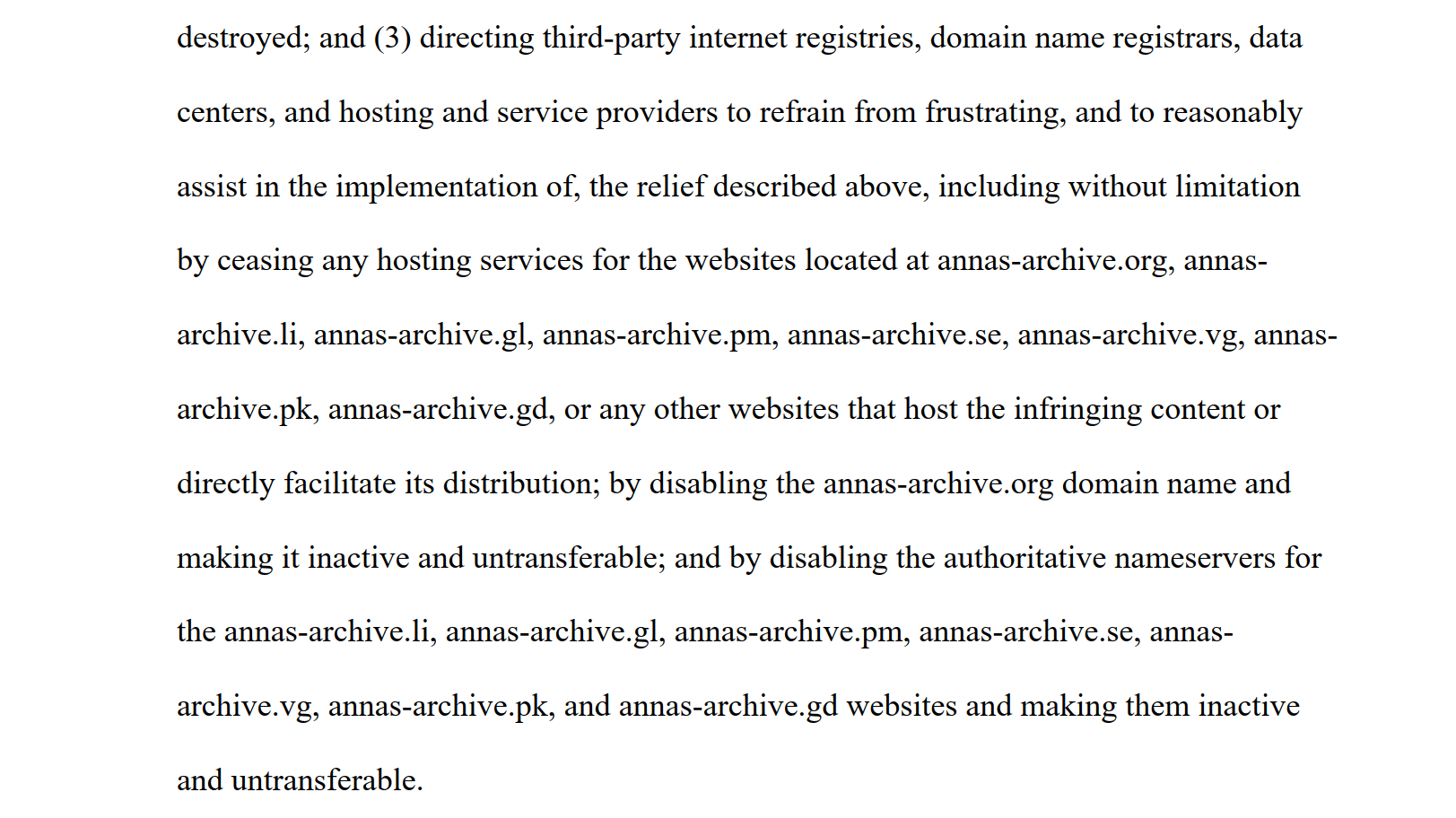
    OCLC is asking the Ohio federal court to grant a broad permanent injunction that would:

    • Ban future harvesting : Prohibit any further scraping of WorldCat.org or OCLC’s servers.
    • Block distribution : Forbid the use, storage, or sharing of the data on Anna’s Archive.
    • Stop incitement : Prevent the site from encouraging others to scrape or distribute the material.
    • Force deletion : Require the destruction of all existing copies of the data, including torrents.

    Footnote & Future Action

    Relying on help from third-party intermediaries to take action against rogue sites is not unique, OCLC notes. In a footnote it links to a recent TorrentFreak article , revealing that Google has removed hundreds of millions of Anna’s Archive URLs from its search index.

    “Enforcing a judgment in this manner would not be uncommon or unexpected as far as Anna’s Archive is concerned. Recently, Google removed over 749 million Anna’s Archive URLs from its search results to stem Anna’s Archive’s large-scale copyright infringement,” the footnote reads.

    The footnote

    footnote

    Of course, there was no court order in Google’s case, it was legally obliged to take action in response to DMCA takedown notices. These typically address copyright complaints, which don’t automatically apply to the metadata that’s at stake here.

    With most of the complex state law questions sidelined, and the monetary demands off the table, Judge Watson has several issues to consider before arriving at a decision concerning a potential judgment and injunction.

    Crucially, OCLC attempts to sidestep the court’s previous concerns about its ‘browsewrap’ contract by arguing that the operators of Anna’s Archive are ‘professional hackers.’

    The motion argues that it is ‘implausible’ that such sophisticated hackers were unaware of the site’s terms of service, regardless of whether they explicitly clicked on an ‘I agree’ button.

    If the court sides with OCLC, the eventual order is expected to trigger a game of infrastructure whack-a-mole, presumably starting with Anna’s Archive’s hosting company.

    A copy of OCLC’s renewed motion for a default judgment against Anna’s Archive is available here (pdf) .

    From: TF , for the latest news on copyright battles, piracy and more.