
call_end

    • chevron_right

      MKVCinemas: ACE Anti-Piracy Coalition Takes Credit For Sudden Shutdown

      news.movim.eu / TorrentFreak • 3 days ago - 11:58 • 4 minutes

    After spending just 20 minutes watching piracy-related uploads on Instagram during the past few weeks, the hard reality of the Indian piracy scene is impossible to ignore.

    In the wake of enforcement action against iBomma, a sprawling streaming platform supposedly blocked back in 2022, it transpires that people refer to the site’s operator using his real name. The media describe Immadi Ravi as a piracy ‘kingpin’, yet to his hyper-enthusiastic fan base, he’s somewhat of a hero, someone to admire and defend.

    Since the 39-year-old is reportedly still behind bars following his arrest at the hands of the Hyderabad Cyber Crime Police during November, the defense aspect may yet find itself put to the test.

    iBomma Down, Bappam TV Down, Other Platforms Too

    On November 15, Telangana police arrested Ravi after reportedly monitoring his activities for the previous three months. The authorities say he operated iBomma from the Caribbean but managed to apprehend him in Kukatpally, Hyderabad, after learning he’d be flying in from France. Ravi reportedly fled the country on October 1 after a case was filed against him.

    At a post-arrest press conference attended by movie suits, directors, producers, and actors, the name and reputation of iBomma founder were placed on the line and then dragged through the mud.

    The claim that Ravi had amassed the personal data of around 5 million users, provided a backdrop of data theft and cybercrime to which other details were soon revealed.

    Ravi’s 21,000-title pirate movie library was slammed for its major contribution to the losses suffered by the industry. In 2024 alone, losses reportedly amounted to 3,700 crore; in U.S. dollars, that’s a significant amount of money: US$428 million, give or take.

    Getting Rich, Making Mistakes

    A student of computer science, Ravi reportedly pocketed Rs 30 crore (US$3.2 million) for himself, deposited in 35 bank accounts, held in cryptocurrency, and otherwise spent to fund a lavish lifestyle.

    Yet, while massively successful, police implied that he wasn’t universally smart. When allegedly purchasing the initial iBomma domain from Njalla, the privacy-focused registrar founded by The Pirate Bay’s Peter Sunde, Ravi reportedly provided his real personal details and paid using a personal debit card.

    “Since he used his own credentials, he cannot deny ownership of the domain,” ACP Srinivasulu said, perhaps forgetting that when acquiring a domain from Njalla, the service retains legal ownership – customers simply get to use them.

    With the two named pirate operations out of action, other sites reportedly went dark too. That’s not unusual, since panic tends to spread rapidly when police start knocking on doors. In the early stages, it can be impossible for outsiders to differentiate between cautious downtime and the effects of a full blown raid. That doesn’t prevent people from trying to connect the dots, however.

    iBomma and Bappam TV – Or Potentially More?

    Describing a globe-trotting life and visits to new countries every week, Hyderabad Additional Commissioner of Police told reporters that Ravi regularly traveled overseas, including to meet with representatives of 1win and 1xBet, the gambling companies said to benefit from his pirate site businesses.

    Officially reported as the operator of iBomma and Bappam TV, widespread unofficial claims state that Ravi was also behind pirate streaming platform MKVCinemas. The site reportedly went dark around the same time as iBomma and Bappam TV.

    In a timely announcement issued Thursday, the Alliance for Creativity and Entertainment says it was responsible for the ‘dismantling’ of MKVCinemas and the shutdown of a “high-traffic drive-to-drive cloning tool” frequently used by piracy services in India and Indonesia.

    “Collectively, the MKVCinemas domains accounted for 142.4 million global visits between 2024 and 2025. The piracy tool received 231.4 million visits in the same time period,” the ACE announcement reads.

    “Following an extensive investigation, ACE identified the operator in Bihar, India, who agreed to shut down the operation and transfer 25 associated domains.”

    Searching For Answers

    There are at least dozens and conservatively well in excess of 100 MKVCinemas-branded domains, so when no domains are mentioned by name, determining which sites were shut down can prove challenging.

    Ultimately, we were able to identify all 25 domains mentioned by ACE and a few others, all confirmed as linked to each other.

    mkvcinemas-seized-pending

    At the time of writing, eight domains have been fully transferred to ACE, but the number will almost certainly increase in the coming hours.

    So are there any proven, likely, or even circumstantial links between MKVCinemas and iBomma?

    Circumstantial Isn’t Good Enough, But India is a Very Big Place

    We already knew that ACE was interested in MKVCinemas back in April 2025, as much was revealed in the documents supporting its application for a DMCA subpoena in the United States.

    ace-v-mkv

    In India, ZeeTV obtained a blocking injunction ( CS(COMM) 650/2022 ) against iBomma in 2022, which included an order to cancel registration of the domain zee5.org, which appears to have been designed to irritate more than anything else.

    Whether ACE or ZeeTV discovered anything useful via the DMCA subpoena and injunction is unknown. That being said, a detail in the ACE statement seems like it could be important.

    “Following an extensive investigation, ACE identified the operator in Bihar, India .”

    In the wake of Ravi’s arrest, actor Konidela Chiranjeevi (known locally as Mega Star), fellow actor Nagarjuna Akkineni, and film director SS Rajamouli, met with Hyderabad city police commissioner VC Sajjanar. According to Indian Express , the men expressed their gratitude, with Chiranjeevi noting how movies had “suffered greatly” while pirates took money from the industry’s pockets.

    “I heard a 22-year-old from Bihar was earning huge money through piracy. It’s unbearable,” he said.

    Hardly conclusive, but we suspect things may be a little more bearable now.

    From: TF , for the latest news on copyright battles, piracy and more.

    • chevron_right

      Rampant U.S. Piracy is a Multibillion-Dollar Concern for Japanese Manga Publishers

      news.movim.eu / TorrentFreak • 5 days ago - 08:41 • 4 minutes

    manga Japan’s government has never been shy about expanding its “ Cool Japan ” campaign, in which manga and anime have become increasingly important export products.

    According to a new government-backed strategy, Japan aims to quadruple its overseas sales of anime, manga, and video games by 2033.

    The goal is to reach 20 trillion yen (~US$133 billion) in overseas sales by 2033. To put that figure in perspective, Japanese officials now explicitly compare this target to the current value of the country’s massive car export industry.

    However, before manga and anime can overtake Toyota and Honda, there’s a massive roadblock to pass.

    The U.S. Piracy Roadblock

    A report on the latest global piracy statistics, released by anti-piracy group Authorized Books of Japan ( ABJ ) and conducted by Photonic System Solutions, shows that manga piracy sites alone draw 2.85 billion monthly visits globally.

    The majority of this traffic goes to English web reading portals, and of all English-speaking countries, the United States is the top consumer of pirated manga, with 317 million monthly visits. That puts the U.S. in third place in terms of global manga piracy consumption, just behind Japan and Indonesia.

    American consumers on average have more to spend than their Indonesian counterparts. So it’s safe to say that U.S. piracy is the main concern for Japan’s export ambitions.

    Rank Country Total Monthly Visits (Millions) Share of Global Traffic
    1 Japan 390.2 13.7%
    2 Indonesia 327.0 11.5%
    3 United States 317.6 11.2%
    4 Thailand 144.6 5.1%
    5 Vietnam 120.2 4.2%

    Source report : Photonic System Solutions / ABJ (June 2025 Data)

    What’s equally concerning for publishers is the apparent normalization of online piracy among manga fans. A separate ABJ behavioral survey found that 30% of U.S. manga readers admit to using unauthorized apps or websites to read content.

    When asked why, American respondents often mention “saving money” as the primary reason. These manga pirates are not necessarily oblivious to copyright concerns, but the survey suggests that they typically make a calculated financial choice.

    The $55 Billion Question

    The piracy visits data is based on June 2025 survey data, in which 914 active manga pirate sites were examined. The majority of these (over 90%) were online reading portals, but some direct download and torrent sites were included too.

    In an attempt to put a number on the financial damage these sites cause, the report uses a rather basic formula to calculate the estimated losses.

    Specifically, the report calculates financial “damage” by taking the time spent on pirate (reading) sites, and multiplying that by the number of mangas that can be read per hour. This figure is then multiplied by the average cost of a manga book: 500 yen (~$3.25).

    The Formula: Hours Spent on Pirate Sites × 2 Books × 500 Yen = Financial Damage

    The report (translated from Japanese)

    lossescalc

    For June 2025, the report calculated that 700 million hours were spent on pirate sites, resulting in a calculated loss of 704.8 billion yen ($4.5 billion) for that single month. That’s $55 billion annually.

    This means that manga piracy losses alone exceed piracy damage estimates cited by the movie or music industries, which seems rather high.

    This report’s damages calculation relies on the classic and controversial “lost sale” fallacy. It assumes that for every hour spent on a pirate site, a user would have otherwise purchased two manga volumes at full retail price.

    In reality, however, there’s no 100% replacement effect. Also, the report does not consider any regional differences, suggesting that piracy in the U.S., Indonesia, and elsewhere is equally damaging.

    Regardless of the economic accuracy, the $55 billion damages figure certainly helps to grab the attention of the Japanese authorities, while also increasing the pressure on other rightsholders.

    U.S. Piracy Intermediaries?

    Not coincidentally, the ABJ report also looked at the domain registrars used by pirate sites. The American company Namecheap came out on top as it’s used by 27% of the sites, followed at a distance by two other U.S. businesses: Namesilo (5%) and GoDaddy (5%).

    Similarly, the earlier-mentioned behavioral survey already identified American platforms as a primary gateway for pirate traffic. It listed Google Search as the number one discovery method for pirate sites, while YouTube was ranked second, with nearly half of surveyed users using the video platform to find pirate mangas.

    Looking at the front-facing IP-addresses of these sites, Cloudflare was linked to 73% of the sites. While the California company doesn’t necessarily host these sites, it is commonly used as a CDN.

    The report doesn’t explicitly state that these intermediaries are liable for pirate sites, but that is ultimately what many rightsholders want.

    Last month, Japanese manga publishers Shueisha, Kodansha, Kadokawa, and Shogakukan booked a key success in this regard. The Tokyo court held Cloudflare liable for damages after it failed to sufficiently prevent manga piracy.

    In response to that court order, Cloudflare warned that it had “serious implications for the efficiency, security, and reliability of the internet”. However, the publishers clearly disagree, and with billions of dollars of export revenues at stake, they have backing from the government and AI technology .

    From: TF , for the latest news on copyright battles, piracy and more.

    • chevron_right

      IPTV Pirate’s Bitcoin Booty Sold at Auction For Just Over $1 Million

      news.movim.eu / TorrentFreak • 6 days ago - 09:33 • 3 minutes

    iptv2-s In common with many countries in Europe, rightsholders in Sweden are attempting to tackle demand for pirate IPTV services and the many suppliers more than willing to meet it.

    Assisted by rightsholders, Swedish law enforcement only has the resources to pursue a relatively small number of cases all the way to prosecution and trial. The case against a man said to be behind one of the most popular platforms was among a select handful of similar cases in recent years.

    Indicted for Copyright Violations

    In 2023, the man was indicted for his alleged ‘involvement’ in Viking IPTV, a pirate IPTV service popular in Sweden and recognized across the Scandinavian region.

    Viking provided access to a wide range of content, and with demand from the public only increasing, the service had no shortage of customers. Anti-piracy group Rights Alliance reported that Viking IPTV had become a well-known brand in Sweden, with a level of business befitting that of a leading provider.

    During the trial at Sweden’s Patent and Market Court (PMD) in May 2024, much evidence was presented to establish the man’s guilt. He had logged into the service’s support email and managed Viking’s Facebook page, among other things. The court also heard that he generated substantial profits from the service.

    Making Money, Moving Cryptocurrency

    In common with similar services, customers of Viking had options to pay: the convenience of PayPal or cryptocurrency.

    Those who opted for Bitcoin sent cash via Swedish mobile payment service Swish to an exchange, with Bitcoin forwarded to wallets operated by unnamed individuals further up the chain. Rights Alliance and the police agreed that the success of the service meant there was plenty of Bitcoin to send.

    Viking IPTV had several thousand customers and turned over a significant amount of money. A police cryptocurrency analysis revealed clusters of Bitcoin wallets linked to the man, which received roughly 308 Bitcoin in the period 2018 to 2022, and worth over US$20 million at the rates prevailing at the time, authorities said.

    Convicted and Sentenced

    In comments to local tabloid Expressen in 2020, the man reportedly boasted of an annual turnover of 12 million kronor, with 80% of that amount being profit. The paper also published snippets of chats which it linked to the operation of Viking IPTV. One message claimed that it had taken just 20 days to generate €75,000, an amount subsequently spent on a new Italian kitchen.

    After being convicted of copyright crimes in May 2024, a total of 12.7 Bitcoin seized by the police were always headed in the wrong direction. Yet, things could’ve been much worse. Rights Alliance reported that the man was handed a suspended prison sentence and ordered to pay daily fines. The length of the suspended sentence and level of daily fines weren’t revealed.

    State Disposes of Pirate Booty

    In an announcement on Monday, Rights Alliance said the convicted man filed an appeal against his conviction but subsequently withdrew it. That meant that the judgment handed down by the Patent and Market Court in 2024 became legally binding.

    In late November, revealed that the Swedish Enforcement Authority ( Kronofogden ) was preparing to dispose of four batches of digital assets in separate auctions.

    The 12.7 bitcoin from the Viking case would have a reserve price of 9 million kronor (US$958.3K) versus a market price at the time estimated at 10.6 million kronor (~US$1.13 million)

    “The preliminary investigation indicates that the man earned significant proceeds from the crime,” Rights Alliance commented on Monday.

    “That criminals earn enormous sums from illegal IPTV is not news; it is evident in most judgments and investigations. The convicted man withdrew his appeal last autumn, and the Patent and Market Court’s ruling thus became legally binding. The Swedish Enforcement Authority has now sold the seized 12.77 Bitcoins for SEK 9,550,000 [~US$1.02 million]. The media describes the sale as a “record auction.”

    While the film and TV company plaintiffs in the case won’t see any return from the money now headed to the public purse, the Court awarded damages to Svensk Filmindustri, Nordisk Film, and several companies from the TV sector.

    Rights Alliance previously said that total damages claims were just under US$1.5 million.

    From: TF , for the latest news on copyright battles, piracy and more.

    • chevron_right

      EU Report Distills AI-Training Lessons from Napster Piracy Era: Don’t Sue, License

      news.movim.eu / TorrentFreak • 7 days ago - 11:53 • 4 minutes

    napster When Napster found its way to millions of desktop computers 25 years ago , the music industry was terrified by this apparent existential threat.

    Determined to make the problem disappear, the legal response was swift. Within a year, the RIAA sued Napster, and artists such as Metallica and Dr. Dre soon followed.

    This strategy seemed to work, as the RIAA lawsuit effectively shut down Napster two years after it launched. However, the genie was out of the bottle, and the ‘magic’ of unlimited access inspired many new sharing apps, such as LimeWire and Kazaa. These new applications eventually ran into trouble as well.

    Report: The Economics of Copyright and AI

    The massive legal response against file-sharing software in the early 2000s shows parallels with today’s copyright clashes between rightsholders and AI companies. Many rightsholders see AI as an existential threat, and there are dozens of high-profile lawsuits on the way. Meanwhile, lawmakers are considering if they need to intervene.

    According to a new report prepared for the European Parliament, lawsuits were not the right answer to piracy, and they are not going to solve the current AI challenges either. Titled “The Economics of Copyright and AI” , the report was commissioned by the European Parliament’s Committee on Legal Affairs (JURI) to help shape future legislation.

    The Economics of Copyright and AI

    ai report

    The report’s author, Christian Peukert , Professor of Digitization, Innovation, and Intellectual Property, has extensively researched both AI and piracy-related copyright challenges in the past.

    Enforcement Doesn’t Work

    The general conclusion is that creating too many barriers to using content for AI training data will harm the economy and the public. Instead, the EU should look to the “lessons from history” provided by online piracy.

    One of the lessons is that early anti-piracy actions and legislation, such as the lawsuits against Napster or new anti-piracy laws in France and Sweden, were largely ineffective. These measures typically led to short-lived sales increases that quickly disappeared, as pirates simply switched to new sites and services.

    The turning point came when licensed downloads and streaming services were made available to the public. Starting with iTunes, which pioneered music downloads, later spreading to streaming services such as Spotify and Netflix.

    “These innovations successfully shifted consumer behavior towards legal consumption. Aggregate data indicate that unlicensed music consumption has been continuously decreasing since 2010, while consumption of unlicensed movie and TV show content has been stagnant and slower to decrease,” Professor Peukert writes.

    Compulsory, Statutory Licensing

    Instead of slowing down AI development by restricting access to copyrighted content, the report suggests a system of compulsory, statutory licensing. This would effectively give AI developers the guaranteed right to use all published works. In exchange, an independent authority would set a royalty rate to compensate rightsholders.

    This would effectively authorize the use of copyrighted works for AI training, as some countries are already doing. However, in this case, rightsholders would receive compensation.

    Key Findings

    statutory license

    Statutory licensing is different from the licensing deals reached with online streaming services such as Spotify and Netflix. The report recognizes that but notes that direct licensing models are not a great solution for the scale of AI training.

    While Spotify deals with a manageable number of record labels and publishers, AI models require training data from the entire internet, including billions of texts, images, and videos. The report argues that identifying and negotiating with millions of individual website owners, creators, and photographers is effectively impossible.

    This individual license approach would be particularly problematic for smaller AI startups, which don’t have the resources to negotiate thousands of deals.

    No Opt-Out

    Perhaps most controversially, the report warns against an “opt-out” model where rightsholders can exclude their content. It argues that opt-outs create “holes” in training data, which will lead to biased AI models.

    From an economic welfare perspective, the report ranks the “opt-out” model as the worst possible option, even worse than doing nothing.

    “When a rightsholder exercises opt-out, they do not take into account that this decreases value for society,” the report notes. The report concludes that rightsholders should not be allowed to opt-out from AI-training under any circumstance.

    Napster Lessons

    In the Napster case 25 years ago, the court explicitly rejected statutory licensing because it would allow an infringer to essentially pay a fine to keep breaking the law.

    The report suggests that, this time around, the logic should be reversed. AI promises massive consumer benefit, estimated at $97 billion annually in the US alone, which is why the report argues that AI development should not be hindered.

    For AI training, companies should be allowed to “continue operations” by paying a fee, because restricting access to copyrighted works would destroy too much economic value.

    “… AI is very different from historical cases of online piracy, as it creates large net benefits for society while using copyrighted works as input. Hence, a regime that allows to ‘continue operations’ is in the best interest of society,” the report reads.

    Napster arguments

    naps

    Based on these historical lessons and detailed economic welfare models, the report sees compulsory statutory licensing as the best way to tackle the AI copyright challenges in Europe. Whether rightsholders and lawmakers will agree has yet to be seen, of course.

    Peukert, C. (2025). The Economics of Copyright and AI. European Parliament, Policy Department for Justice, Civil Liberties and Institutional Affairs. doi:10.2861/0246137 ( pdf )

    From: TF , for the latest news on copyright battles, piracy and more.

    • chevron_right

      Bypass Amazon Fire TV Stick Piracy Ban and See What Happens Next

      news.movim.eu / TorrentFreak • 7 December • 5 minutes

    beetv1 Generally speaking, pirates tend to dislike restrictions, because more often than not, restrictions mean either less piracy or less convenient piracy.

    News from Amazon last month indicated that apps linked to piracy would start to face new restrictions when sideloaded to Fire TV devices, although exactly how that would manifest itself was still unknown.

    The ‘announcement’ was ‘quietly’ delivered via the media and spread quickly. That produced predictable headlines, mostly warning of an Amazon Crackdown / Piracy Ban plus additional drama conjured up from nowhere.

    First Apps Flagged By Amazon

    While there are reports that more than one app has been flagged by Amazon since then, one stands out for being reported most often, backed up by independent screenshots showing Amazon’s message.

    BeeTV is an Android-based app providing access to pirated movies and TV shows. In one form or another, BeeTV apps have been around for years. That’s not because of longevity and continuity as a single app, but because anyone with an app looking for installs can put a BeeTV logo on it and get instantly recognized.

    As the image shows, when Fire TV users tried to sideload a BeeTV app, Amazon spotted it too.

    BeeTV Meets Amazon ‘Crackdown’ beetv-warning

    While the message is clear, Amazon’s alleged crackdown is accompanied by a convenient one-click circumvention option. This is not exactly as some have advertised, and it may, or may not, be the start of a tapered approach..

    For some, that’s still enough to arouse scattered suspicions that ‘Launch Anyway’ could lead to being flagged by the authorities or reported to anti-piracy groups. Theoretical consequences such as these do give some people pause for thought, but overall deterrent value seems limited, as the disguised Reddit thread below suggests.

    What Happens After ‘Launch Anyway’? NOTHING reddit

    So does nothing happen, or does nothing appear to happen?

    Something Happens: Free Movies & TV Shows plus Bonus Extras

    The most popular BeeTV variants appear to be at versions 4.4.4 to 4.4.7, with various MOD versions promising no advertising. We carried out a series of tests on all three versions and can report that many things can happen, but conveniently the user sees nothing.

    Our assessment here is based on what an app like this needs to function. For pragmatic reasons, allowances are made for monetization via ads etc. with additional ‘functionality’ viewed case-by-case. Declared permissions that go beyond those needed for a regular app to provide the same services are generally unacceptable by default.

    Without granting permission to access the internet, not much will happen, and in the event functionality exists to download a video, denying access to external storage would be an issue too. Let’s assume all permissions are granted, and since many users will also sideload the app onto their cellphones, we will cover some of the main issues across all devices at the same time.

    Permissions Permissions Permissions

    Here’s just some of what the app can do, beyond what it needs to be able to do. We’ll consider the implications later.

    Location: Even with allowances made for access to localized content, identifying the user’s approximate location is not the same as always being able to identify a user’s location accurate to a few feet.

    External Storage Read/Write: The app has broad access to external storage, including read/write permissions. What people store on their devices tends to vary depending on the individual.

    Bookmarks/Browsing History: Tests indicate the app not only has permission to read bookmarks and browsing history, it can write to them as well.

    Other Security Issues of Concern

    SMS/Call Logs: When providing access to a movie or TV show, there’s no reason why the app should obtain the name of the device’s network operator. Being able to query a user’s SMS messages and obtain their content definitely isn’t needed, nor is it acceptable to query a device’s contact list, or access its call logs.

    There are also some serious issues on the technical side outside the scope of this article, but one apparent double standard is worth highlighting.

    On one hand, the app uses SSL certificate pinning to prevent MITM attacks (eavesdropping) on communications it aims to keep private. On the other, it proactively enables cleartext traffic, which enables eavesdropping (and modification) of transmitted data it presumably wishes to see (and potentially tamper with), without being detected by the user.

    What Could Possibly Go Wrong?

    Apart from intercepting unencrypted network traffic, potentially including credentials, API keys, and other sensitive information, a potential attacker could track the user’s location in real-time. This could enable anything from stalking to targeted phishing attacks based on known daily routines, augmented by information from contact lists, call logs, and the content of SMS data.

    If more data was needed to carry out identity theft, a simulated identity theft warning sent to the user by SMS, claiming to be from the user’s own bank (confirmed by entries in their contact list and SMS), could lead to some people clicking a link to a bogus banking page. They might even be persuaded to hand over the rest of their info.

    Of course, savvy users don’t click links in unsolicited messages, it’s too risky. Instead, they visit their own bank with a communication that they themselves initiate; just quickly dig out the bookmark and……

    Almost Nothing Happens?

    In summary, then, aside from launching at boot and the ability to install additional software, the app can harvest personal information, obtain information on contacts, and the content of their messages on the device. It can intercept communications, manipulate device behavior, and track movements and activities in real-time, while recording locations (home, workplace, gym) and times.

    On the plus side, version 4.4.4 does not appear to have the ability to use a device’s camera to photograph anything it likes, at any time, without the user’s knowledge or permission. It’s an oversight that seems to have been ‘corrected’ in 4.4.7.

    There are the movies and TV shows to consider, of course, accessed from well over 200 pirate site domains embedded in the app. There’s also the superficially ‘clean’ detection reports on VirusTotal to put any remaining doubts to rest.

    A fitness app carrying out 24/7 monitoring wouldn’t be flagged for being malicious, and there’s not much difference in this case either. The app asked for permission, and without considering intent, permission was granted. There’s not much that can be done about that.

    From: TF , for the latest news on copyright battles, piracy and more.

    • chevron_right

      Lithuanian Watchdog Fines Torrent Tracker Users for Pirating Local Blockbuster

      news.movim.eu / TorrentFreak • 6 December • 2 minutes

    chronicles In 2023, Lithuania amended its Code of Administrative Offenses, allowing media watchdog LRTK to fine pirates, without going to court.

    This legislative change was specifically designed to deter piracy in the European country. With potential fines on the line, pirates would reconsider their habits, the idea was.

    Tracking Torrent Tracker Pirates

    Over the past two years, dozens of fines were handed out. The targets were mostly first-time offenders who received the minimum fine of 140 euros. For repeat offenses, however, fines can potentially reach 850 euros.

    What makes these fines stand out is that LRTK predominantly targets users of the private torrent trackers Linkomanija and Torrent.lt. These are two of the most-visited pirate sites in the Eastern European country.

    The media watchdog does not only target local piracy communities; it also focuses on protecting locally produced media. In a recent announcement, LRTK notes that, this year, it fined more than 30 people who shared a copy of the film “ Pietinia Kronikas ” (The Southern Chronicles).

    These targets are again linked to the Linkomanija and Torrent.lt torrent trackers, and ten of them were fined in November, suggesting an increase in enforcement activity.

    In most cases, the suspects were fined in their absence, as they failed to respond to inquiries from the media watchdog.

    “The LRTK contacted the violators in writing, requesting explanations and inviting them to participate in the investigation of the administrative offense. However, the majority of individuals did not respond to the invitations and failed to appear for the investigation,” LRTK writes.

    From 250+ Blocked Domains to Malware Threats

    In addition to targeted fines, the regulator is also expanding its site blocking efforts. According to new figures, LRTK blocked more than 700 IP addresses and 250 domain names linked to pirate sites in 2025 alone.

    Andrius Katinas, Head of the Supervision Division at LRTK, admits that while piracy activity has decreased, it remains a significant problem. Therefore, the regulator is adding a “consumer safety” narrative by warning that pirate sites are linked to malware and other cyber threats.

    In a report by local news outlet Delfi, the watchdog links pirate sites to data theft, malicious software, ransomware, stolen credit cards or bank details, compromised accounts, and hacked social media.

    “These cases constantly happen,” Katinas warns. “Individuals who lost access to their personal or work accounts often receive offers to recover them for a ransom, are threatened with the publishing of compromising content, or are otherwise manipulated.”

    Changing Piracy Rates?

    There is no silver bullet to stop piracy. While site blocking, fines, and awareness campaigns have some effect, some people continue to return to pirate sites. That includes the heavily targeted Linkomanija and Torrent.lt trackers.

    Historically, piracy rates have always been high in Lithuania, but, according to LRTK Chairman Mantas Martišius, piracy is now clearly on the decline.

    Martišius notes that enforcement has paid off. Importantly, however, the economic situation in Lithuania is improving, so people now have the opportunity to spend money on legal platforms and services.

    All in all, LRTK is adamant that its efforts to curb piracy are paying off. That becaome apparent earlier this year when the watchdog publicly criticized data reported by piracy tracking firm MUSO, stressing that “Lithuania is no longer the leader in piracy”.

    From: TF , for the latest news on copyright battles, piracy and more.

    • chevron_right

      Belgium’s Latest Pirate Site-Blocking Order Spares DNS Providers

      news.movim.eu / TorrentFreak • 5 December • 3 minutes

    stop danger Over the past few months, Belgium has issued several site-blocking orders targeting hundreds of piracy-linked domain names.

    These blockades follow a newly instated two-step process. A local court first issues a blocking order, after which a special government body determines how it will be implemented. This process aims to prevent errors and overblocking.

    Pirate DNS Blocking

    While site blocking is common in Europe, these new Belgian blockades go beyond the typical ISP blockade. Similar to France and Italy , the orders were also directed at third-party public DNS resolvers.

    The first implementation order, issued by the Belgian Department for Combating Online Infringement in April , required both ISPs and DNS resolvers to restrict access to pirate sites. Specifically, Cloudflare, Google, and Cisco’s OpenDNS were ordered to stop resolving over 100 pirate sites or face fines of €100,000 euros per day.

    This order prompted significant pushback, most notably from Cisco, which ceased operating its OpenDNS service in Belgium soon after the order was announced.

    In July, another order by the Belgian authority ordered blockades of shadow library websites, including Libgen, Zlibrary, and Anna’s Archive. This sweeping court order required ISPs to take action and also involved other intermediaries, such as hosting providers, search engines, and DNS services.

    The underlying court order also called for a broad blockade of the Internet Archive’s Open Library service. While that was ultimately prevented , the involvement of a broad range of intermediaries caused concern about the escalating scope of the blocking orders.

    New ‘Limited’ Piracy Blocking Order

    On November 26, the Belgian Department for Combating Online Infringement published a new blocking implementation order. While this effectively adds dozens of new domains to the Belgian blocklist, the scope of this order is surprisingly limited.

    Instead of casting a wide net, the order strictly targets Belgium’s five major Internet Service Providers: Proximus, Telenet, Orange Belgium, DIGI Communications Belgium, and Mobile Vikings.

    From the order

    orderbel

    The list of “addressees” no longer includes the DNS resolvers, Google, Cloudflare, and Cisco, which were central targets in the April blocking order. There is no mention of hosting services, advertisers, or other intermediaries either.

    The official implementation order does not mention the rightsholder(s) who requested the blocking measures, nor does it mention the targeted sites. However, the blocked domains are published in a separate spreadsheet showing that 1337x, Fmovies, Soap2Day, and Sflix branded domains are among the key targets.

    From the blocking spreadsheet

    block

    Since these pirate targets often switch domain names to evade enforcement, rightsholders can submit a new list of mirror sites or proxies once per week, capped at 50 new domains per week. When these are approved by the Belgian Department, ISPs have five working days to update the blocklist.

    Retreat or a Pause?

    The decision to exclude DNS resolvers from this latest order is likely not a coincidence. It might very well be a direct consequence of the legal pushback Cisco initiated earlier this year, when it appealed the April blocking order at the Brussels Business Court.

    This appeal was not without result, as the court suspended enforcement of that blocking order against Cisco in July, after which OpenDNS became available again in Belgium.

    “The OpenDNS service has been reactivated in Belgium following a decision by the Brussels court to suspend enforcement of the order requiring Cisco to implement DNS blocking measures. The suspension of the order is pending a final ruling in the legal proceedings which remain ongoing,” a Cisco representative wrote in a community update .

    To find out more about the suspended blocking measures, we reached out to the Belgian Department for Combating Online Infringement, which did not respond to our inquiry. Without further details, we don’t know whether the suspension also applies to other DNS resolvers. Confusingly, the official transparency portal makes no mention of an appeal at all.

    It is likely, however, that since the legality of the blocking orders against third-party DNS resolvers is still being litigated, rightsholders have chosen to limit their blocking requests to ISPs. This would suggest that it’s a pause, not a formal retreat.

    A copy of the latest blocking implementation order, published by the Department for Combating Infringements of Copyright and Related Rights Committed Online and the Illegal Exploitation of Online Games of Chance on the 26th of November, 2025, is available here (pdf) .

    The full blocking spreadsheet, last updated November 26, is available at the Belgian government website .

    From: TF , for the latest news on copyright battles, piracy and more.

    • chevron_right

      Court Empowers Hollywood in Race to Block “Wicked: For Good” Piracy

      news.movim.eu / TorrentFreak • 4 December • 3 minutes

    mpa-eye While Australia’s site-blocking mechanism has made few enemies since 2018, it hasn’t been known for being fast.

    As discussed earlier this year , accuracy has traditionally been favored over speed, which is contrary to less cautious approaches taken in other countries.

    After an unprecedented request and cooperation from the Federal Court, Australia will now step up several gears and show whether it can achieve both.

    Not Just Another Blocking Order

    When Justice Halley handed down his order in Universal City Studios LLC v Telstra Limited [2025] FCA 1390 on November 12, in most respects it was much like any other issued in recent years.

    Member studios of the MPA – Universal, Disney, Paramount, Columbia, Warner Bros., Netflix and Apple (plus Viacom) requested an injunction under Section 115A of the Copyright Act, requiring around 50 local ISPs (operating as Telstra, Optus, Vocus, TPG Telecom, Aussie Broadband and Superloop) to block 52 overseas-based pirate streaming sites.

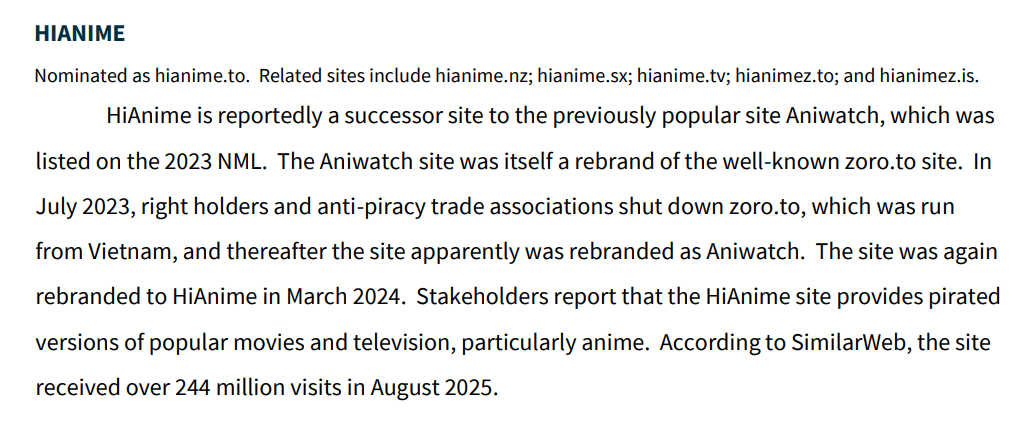
    The copyright works applicants aim to protect necessarily play a key role in blocking proceedings. The difference in this case was the emphasis placed on the Universal Pictures movie Wicked: For Good and its inevitable appearance on high-traffic sites using familiar branding: HydraHD, Hurawatch, Braflix, Soap2Day, MyFlixer, HiAnime, OnionPlay, 123movies, SolarMovies, Gomovies, Fmovies – the list goes on……and on.

    With Wicked: For Good ‘s international release scheduled for November 17, Australian ISPs agreed to take all reasonable steps to disable access to 23 sites as a matter of urgency, with the remaining 29 to be blocked within the usual span of 15 business days.

    In order to have a fighting chance against adaptable piracy platforms, a dynamic blocking order was issued, meaning that new domains and IP addresses could be added to deal with the inevitable countermeasures. Under normal circumstances, that can take time but for Wicked: For Good ‘s theatrical release in Australia, time was already running out.

    Additional Urgent Access Means

    Less than two weeks after handing down the initial order, Justice Halley was handing down a second. Dated November 25, the order reveals that studios filed an urgent application for an order to tackle countermeasures deployed by the sites.

    Operating from new domains, described in the order as “Additional Urgent Access Means”, the sites were already illegally distributing Wicked: For Good which was set to continue playing in theaters in Australia until the end of 2025.

    New domains, IP addresses, and/or URLs are normally reported by rightsholders to the ISPs, who are then expected to respond within seven working days. If neither the respondent nor the court requires the matter to be relisted, the ISPs have a further 15 working days to disable access.

    The prospect of the movie being distributed unhindered for free until Christmas Eve was considered unacceptable.

    Urgent Additional Blocking Order

    On November 28, just over two weeks after handing down the initial blocking order, Justice Halley authorized a second.

    In response to the studios’ calls for urgency, Universal City Studios LLC v Telstra Limited [2025] FCA 1485 targeted the ‘Additional Urgent Access Means’ (new domain names/IP addresses/URLs) deployed by the sites to circumvent the previously implemented blocks.

    The court recognized that standard procedures, which require notification and then a response period, would allow the sites to operate unhindered for at least 22 days.

    “This would have the consequence that those sites would remain accessible for the majority of the theatrical release period for the film ‘Wicked: For Good’ which would have the likely effect of reducing the commercial success of the film as infringing copies of the film would be available without charge from the Additional Urgent Access Means,” Justice Halley noted in his order.

    Rapid Response

    To combat this, the new order required the ISPs to disable access to the new means of access, whether domain names, IP addresses, or URLs, by 4.00 pm on Friday, November 28, 2025. As far as we’re aware, a response time this short is unprecedented in Australia.

    The ability to quickly respond to blocking countermeasures is crucial. For Australia, this is new territory but shouldn’t be unnecessarily difficult. However, as months of delay have decreased to weeks and now just days, rightsholders elsewhere in the world – especially in the live sports arena – still aren’t satisfied, even when blocking takes place within hours. In some areas, rightsholders consider 10 minutes to be reasonable.

    Under those demands, Australia’s traditional accuracy would face challenges, with or without a reduction in overall piracy rates. Right now, despite aggressive worldwide blocking measures, piracy continues to trend up.

    The orders dated November 12 and November 28 are available here and here

    From: TF , for the latest news on copyright battles, piracy and more.

    • chevron_right

      DDoS Guard: LaLiga’s Piracy Blocks Test Whether Anyone Will Protect the Internet

      news.movim.eu / TorrentFreak • 3 December • 5 minutes

    judge-block A report published by the European Commission last month assessed whether its Recommendation of May 2023 had made a difference in the fight against pirated streams.

    No significant improvement ” was the downbeat conclusion.

    From the perspective of top-tier Spanish football league, LaLiga, new legislation is the only workable solution, and it needs to be implemented in Europe, sooner rather than later.

    LaLiga Claims to Have Slashed Piracy in Half, Give or Take

    At the same time as urgently calling for new legislation, LaLiga claims to have reduced piracy of its content in Spain by as much as 60% . This was achieved under existing legislation for the season that concluded at the end of the summer. A 40% reduction, the lower figure previously cited by LaLiga, would still be unprecedented.

    Yet, in the context of LaLiga’s court-ordered authority, which permits aggressive blocking of almost any site or service facilitating access to pirate streams of its premium content, such results are not absolutely impossible, at least in measured short bursts. LaLiga regularly laments Cloudflare’s refusal to prevent piracy platforms from using its services and for every week that remains the case, Cloudflare IP addresses – utilized by pirates and regular customers alike – are blocked by Spanish ISPs.

    LaLiga reports that in May 2025, 38% of piracy involving LaLiga content “was distributed through Cloudflare’s infrastructure.” So at least on paper and without considering circumvention and other factors, aggressive yet effective blocking of Cloudflare would in theory be sufficient to claim a ~40% reduction in piracy rates.

    The problem, which has thus far proven impossible to solve, is how blanket denial of service to piracy platforms can be executed without subjecting innocent parties to the same fate.

    Internet Private Security Guard

    As Head of Web Application Protection at DDoS-Guard , a Russian Internet company providing protective online services, Dmitry Nikonov understands the importance of connectivity. Operating in broadly the same market as Cloudflare, DDoS-Guard has been paying close attention to the events playing out in Spain.

    LaLiga’s legal authority allows it to block Cloudflare and in the event that DDoS-Guard’s services also become a concern, there would be no legal barrier to prevent it from being treated in much the same way. The consequences of non-compliance seem to have alarmed Nikonov.

    “This is happening right now, in the fall of 2025, and the scale of this phenomenon is astonishing. It seems LaLiga is beyond control,” Nikonov writes in a column for Forbes Russia .

    “LaLiga can essentially apply a ‘piracy’ mask to entire ranges of addresses, often affecting endpoints that are not directly related to illegal broadcasts.”

    ‘Private Regulation’ of the Internet

    Nikonov believes the authority delegated to LaLiga should serve as a wake-up call for the global internet. He says that the authority to interfere with internet functioning has elevated the company to a powerful position; the big question is whether anyone can do anything about it.

    “LaLiga is becoming a private regulator: not a state or an independent regulator, but a commercial organization that has delegated authority to interfere with network infrastructure. Football matches have become the pretext for a large-scale experiment on the internet, testing whether there is anyone to protect its freedom,” Nikonov says.

    “If the football league has such powers today, then nothing will stop other major players from acquiring them tomorrow. We’re talking about media holdings, streaming companies, and corporations for whom content is not entertainment, but a source of profit.”

    Trade Barriers, No Legal Recourse

    In a late October submission to the 2026 National Trade Assessment Report, Cloudflare warned the Trump administration that Spanish courts allow rightsholders to request “overbroad court orders” that cause collateral damage affecting tens of thousands of legitimate websites.

    Since the Spanish government has chosen not to intervene, and “no judicial opportunity for remedy” currently exists, Cloudflare said that creates “significant trade barriers between the countries.”

    Nikonov uses similar terms to those used in a Cloudflare-commissioned report released in the summer . “The internet will become fragmented,” he says, before reminding readers that state institutions won’t be responsible, but commercial organizations shielded by government.

    “This scheme avoids public debate (the Spanish parliament refused to consider the issue, citing a court ruling) and instead considers the proportionality of the measures. Under the guise of copyright protection, a tool is emerging that allows commercial players to directly influence the accessibility of parts of the internet, bypassing legal proceedings.

    “Access to resources will be determined not by technical standards, but by the interests of private corporations with administrative resources,” he warns.

    More Powerful Tools Than Previously Reported?

    Nikonov suggests that more powerful tools are being deployed in Spain, beyond simple DNS blocking. He claims that a key role belongs to the National Telecommunications Market Commission (CNMC), which, at the behest of LaLiga issues “mandatory directives” to all Spanish ISPs, urging “the fastest possible compliance.”

    “[This] effectively forces them to implement DNS and BGP filtering. Border Gateway Protocol is the primary dynamic routing protocol on the internet,” he continues.

    A phrase often used to convey the importance of BGP is simple but effective: BGP is the glue that holds the internet together . That’s not overblown or alarmist ; but some would argue that meddling with it is.

    “As a result, telecom operators are becoming the enforcers of state anti-piracy policies. What we’re facing is no longer an isolated failure, but a testing of a model that sets a precedent for new internet governance — a private corporation, through the regulator, gains de facto access to leverage over network infrastructure.”

    Regulation and Using the Same System For ‘Something Else’

    It’s possible that at some point there will be calls for site blocking to be regulated, but according to Nikonov, some may welcome that with open arms.

    “[M]odern digital ecosystems are structured in such a way that anyone who gains access to regulatory levers automatically gains power over the infrastructure used by millions of people. In other words, the internet today is no longer a distributed network, but a set of control points, each of which becomes a juicy target,” he notes.

    “And if today this point is used to protect football broadcasts, tomorrow it will be used for something entirely different.”

    From: TF , for the latest news on copyright battles, piracy and more.