call_end

    • chevron_right

      Ignite Realtime Blog: Smack 4.5.0-beta5 released

      news.movim.eu / PlanetJabber • 17 October, 2024

    The Ignite Realtime developer community is happy to announce that Smack 4.5 entered its beta phase. Smack is a XMPP client API written in Java that is able to run on Java SE and Android. Smack’s beta phase started already a few weeks ago, but 4.5.0-beta5 is considered to be a good candidate to announce, as many smaller issues have been ironed out.

    With Smack 4.5 we bumped the minimum Java version to 11. Furthermore Smack now requires a minimum Android API of 26 to run.

    If you are using Smack 4.4 (or maybe an even older version), then right now is the perfect time to create an experimental branch with Smack 4.5 to ease the transition.

    Smack 4.5 APIs is considered stable, however small adjustments are still possible during the beta phase.

    1 post - 1 participant

    Read full topic

    • chevron_right

      Erlang Solutions: Why Open Source Technologies is a Smart Choice for Fintech Businesses

      news.movim.eu / PlanetJabber • 10 October, 2024 • 11 minutes

    Traditionally, the fintech industry relied on proprietary software , with usage and distribution restricted by paid licences. Fintech open-source technologies were distrusted due to security concerns over visible code in complex systems.

    But fast-forward to today and financial institutions, including neobanks like Revolut and Monzo, have embraced open source solutions. These banks have built technology stacks on open-source platforms, using new software and innovation to strengthen their competitive edge.

    While proprietary software has its role, it faces challenges exemplified by Oracle/Java’s subscription model changes, which have led to significant cost hikes. In contrast, open source Delivers flexibility, scalability, and more control, making it a great choice for fintechs aiming to remain adaptable.

    Curious why open source is the smart choice for fintech? Let’s look into how this shift can help future-proof operations, drive innovation, and enhance customer-centric services.

    The impact of Oracle Java’s pricing changes

    Before we understand why open source is a smart choice for fintech, let’s look at a recent example that highlights the risks of relying on proprietary software—Oracle Java’s subscription model changes.

    A change to subscription

    Java, known as the “language of business,” has been the top choice for developers and 90% of Fortune 500 companies for over 28 years, due to its stability, performance, and strong Oracle Java community.

    In January 2023, Oracle quietly shifted its Java SE subscription model to an employee-based system, charging businesses based on total headcount, not just the number of users. This change alarmed many subscribers and resulted in steep increases in licensing fees. According to Gartner , these changes made operations two to five times more expensive for most organisations.

    Fintech open source Java SE universal products

    Oracle Java SE Universal Subscription Global Price List (by volume)

    Impact on Oracle Java SE user base

    By January 2024, many Oracle Java SE subscribers had switched to OpenJDK, the open-source version of Java. Online sentiment towards Oracle has been unfavourable, with many users expressing dissatisfaction in forums. Those who stuck with Oracle are now facing hefty subscription fee increases with little added benefit.

    Lessons from Oracle Java SE

    For fintech companies, Oracle Java’s pricing changes have highlighted the risks of proprietary software. In particular, there are unexpected cost hikes, less flexibility, and disruptions to critical infrastructure. Open source solutions, on the other hand, give fintech firms more control, reduce vendor lock-in, and allow them to adapt to future changes while keeping costs in check.

    The advantages of open source technologies for Fintech

    Open source software is gaining attention in financial institutions, thanks to the rise of digital financial services and fintech advancements.

    It is expected to grow by 24% by 2025 and companies that embrace open-source benefit from enhanced security, support for cryptocurrency trading, and a boost to fintech innovation.

    Cost-effectiveness

    The cost advantages of open-source software have been a major draw for companies looking to shift from proprietary systems. For fintech companies, open-source reduces operational expenses compared to the unpredictable, high costs of proprietary solutions like Oracle Java SE.

    Open source software is often free, allowing fintech startups and established firms to lower development costs and redirect funds to key areas such as compliance, security, and user experience. It also avoids fees like:

    • Multi-user licences
    • Administrative charges
    • Ongoing annual software support charges

    These savings help reduce operating expenses while enabling investment in valuable services like user training, ongoing support, and customised development, driving growth and efficiency.

    A solution to big tech monopolies

    Monopolies in tech, particularly in fintech, are increasing. As reported by CB Insights , about 80% of global payment transactions are controlled by just a few major players. These monopolies stifle innovation and drive up costs.

    Open-source software decentralises development, preventing any single entity from holding total control. It offers fintech companies an alternative to proprietary systems, reducing reliance on monopolistic players and fostering healthy competition. Open-source models promote transparency, innovation, and lower costs, helping create more inclusive and competitive systems.

    Transparent and secure solutions

    Security concerns have been a major roadblock that causes companies and startups to hesitate in adopting open-source software.

    A common myth about open source is that its public code makes it insecure. But, open-source benefits from transparency, as it allows for continuous public scrutiny. Security flaws are discovered and addressed quickly by the community, unlike proprietary software, where vulnerabilities may remain hidden.

    An example is Vocalink , which powers real-time global payment systems. Vocalink uses Erlang , an open-source language designed for high-availability systems, ensuring secure, scalable payment handling. The transparency of open source allows businesses to audit security, ensure compliance, and quickly implement fixes, leading to more secure fintech infrastructure.

    Ongoing community support

    Beyond security, open source benefits from vibrant communities of developers and users who share knowledge and collaborate to enhance software. This fosters innovation and accelerates development, allowing for faster adaptation to trends or market demands.

    Since the code is open, fintech firms can build custom solutions, which can be contributed back to the community for others to use. The rapid pace of innovation within these communities helps keep the software relevant and adaptable.

    Interoperability

    Interoperability is a game-changer for open-source solutions in financial institutions, allowing for the seamless integration of diverse applications and systems- essential for financial services with complex tech stacks.

    By adopting open standards (publicly accessible guidelines ensuring compatibility), financial institutions can eliminate costly manual integrations and enable plug-and-play functionality. This enhances agility, allowing institutions to adopt the best applications without being tied to a single vendor.

    A notable example is NatWest’s Backplane , an open-source interoperability solution built on FDC3 standards. Backplane enables customers and fintechs to integrate their desktop apps with various banking and fintech applications, enhancing the financial desktop experience. This approach fosters innovation, saves time and resources, and creates a more flexible, customer-centric ecosystem.

    Future-proofing for longevity

    Open-source software has long-term viability. Since the source code is accessible, even if the original team disbands, other organisations, developers or the community at large can maintain and update the software. This ensures the software remains usable and up-to-date, preventing reliance on unsupported tools.

    Open Source powering Fintech trends

    According to the latest study by McKinsey and Company , Artificial Intelligence (AI), machine learning (ML), blockchain technology, and hyper-personalisation will be among some of the key technologies driving financial services in the next decade.

    Open-source platforms will play a key role in supporting and accelerating these developments, making them more accessible and innovative.

    AI and fintech innovation

    • Cost-effective AI/ML : Open-source AI frameworks like TensorFlow , PyTorch , and Scikit -learn enable startups to prototype and deploy AI models affordably, with the flexibility to scale as they grow. This democratisation of AI allows smaller players to compete with larger firms.
    • Fraud detection and personalisation : AI-powered fraud detection and personalised services are central to fintech innovation. Open-source AI libraries help companies like Stripe and PayPal detect fraudulent transactions by analysing patterns, while AI enables dynamic pricing and custom loan offers based on user behaviour.
    • Efficient operations : AI streamlines back-office tasks through automation, knowledge graphs, and natural language processing (NLP), improving fraud detection and overall operational efficiency.
    • Privacy-aware AI : Emerging technologies like federated learning and encryption tools help keep sensitive data secure, for rapid AI innovation while ensuring privacy and compliance.

    Blockchain and fintech

    Open-source blockchain platforms allow fintech startups to innovate without the hefty cost of proprietary systems:

    • Open-source blockchain platforms : Platforms like Ethereum , Bitcoin Core, and Hyperledger are decentralising finance, providing transparency, reducing reliance on intermediaries, and reshaping financial services.
    • Decentralised finance (DeFi) :  DeFi is projected to see an impressive rise, with P2P lending growing from $43.16 billion in 2018 to an estimated $567.3 billion by 2026 . Platforms like Uniswap and Aave , built on Ethereum, are pioneering decentralised lending and asset management, offering an alternative to traditional banking. By 2023, Ethereum alone locked $23 billion in DeFi assets, proving its growing influence in the fintech space. Enterprise blockchain solutions: Open source frameworks like Hyperledger Fabric and Corda are enabling enterprises to develop private, permissioned blockchain solutions, enhancing security and scalability across industries, including finance.

    Cost-effective innovation: Startups leveraging open-source blockchain technologies can build innovative financial services while keeping costs low, helping them compete effectively with traditional financial institutions.

    Hyper-personalisation

    Hyper-personalisation is another key trend in fintech, with AI and open-source technologies enabling companies to create highly tailored financial products. This shift moves away from the traditional “one-size-fits-all” model, helping fintechs solve niche customer challenges and deliver more precise services.

    Consumer demand for personalisation

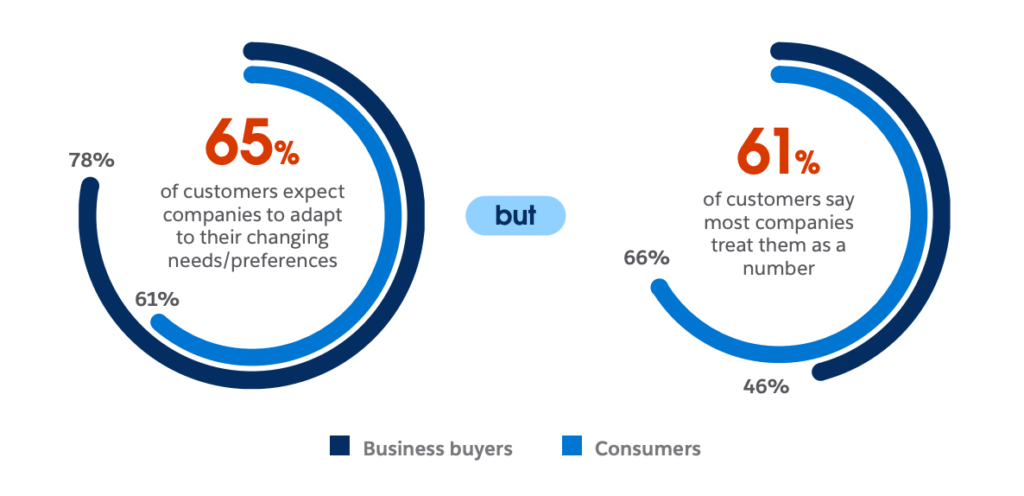
    A Salesforce survey found that 65% of consumers expect businesses to personalise their services, while 86% are willing to share data to receive more customised experiences.

    Salesforce survey fintech open source businesses

    source- State of the connected customer

    The expectation for personalised services is shaping how financial institutions approach customer engagement and product development.

    Real-world examples of open-source fintech

    Companies like Robinhood and Chime leverage open-source tools to analyse user data and create personalised financial recommendations. These platforms use technologies like Apache Kafka and Apache Spark to process real-time data, improving the accuracy and relevance of their personalised offerings-from customised investment options to tailored loan products.

    Implementing hyper-personalisation lets fintech companies strengthen customer relationships, boost retention, and increase deposits. By leveraging real-time, data-driven technologies, they can offer highly relevant products that foster customer loyalty and maximise value throughout the customer lifecycle. With the scalability and flexibility of open-source solutions, companies can provide precise, cost-effective personalised services, positioning themselves for success in a competitive market.

    Erlang and Elixir: Open Source solutions for fintech applications

    Released as open-source in 1998 , Erlang has become essential for fintech companies that need scalable, high-concurrency, and fault-tolerant systems. Its open-source nature, combined with the capabilities of Elixir (which builds on Erlang’s robust architecture), enables fintech firms to innovate without relying on proprietary software, providing the flexibility to develop custom and efficient solutions.

    Both Erlang and Elixir’s architecture are designed to ensure potentially zero downtime, making them well-suited for real-time financial transactions.

    Why Erlang and Elixir are ideal for Fintech:

    • Reliability : Erlang’s and Elixir’s design ensures that applications continue to function smoothly even during hardware or network failures, crucial for financial services that operate 24/7, guaranteeing uninterrupted service. Elixir inherits Erlang’s reliability while providing a more modern syntax for development.
    • Scalability : Erlang and Elixir can handle thousands of concurrent processes, making them perfect for fintech companies looking to scale quickly, especially when dealing with growing data volumes and transactions. Elixir enhances Erlang’s scalability with modern tooling and enhanced performance for certain types of workloads.
    • Fault tolerance: Built-in error detection and recovery features ensure that unexpected failures are managed with minimal disruption. This is vital for fintech applications, where downtime can lead to significant financial losses. Erlang’s auto restoration philosophy and Elixir’s features enable 100% availability and no transaction is lost.
    • Concurrency & distribution : Both Erlang and Elixir excel at managing multiple concurrent processes across distributed systems. This makes them ideal for fintechs with global operations that require real-time data processing across various locations.

    Open-source fintech use cases

    Several leading fintech companies have already used Erlang to build scalable, reliable systems that support their complex operations and real-time transactions.

    • Klarna : This major European fintech relies on Erlang to manage real-time e-commerce payment solutions, where scalability and reliability are critical for managing millions of transactions daily.
    • Goldman Sachs : Erlang is utilised in Goldman Sachs’ high-frequency trading platform, allowing for ultra-low latency and real-time processing essential for responding to market conditions in microseconds.
    • Kivra : Erlang/ Elixir supports Kivra’s backend services, managing secure digital communications for millions of users, and ensuring constant uptime and data security.

    Erlang and Elixir -supporting future fintech trends

    The features of Erlang and Elixir align well with emerging fintech trends:

    • DeFi and Decentralised Applications (dApps) : With the growth of decentralised finance (DeFi), Erlang’s and Elixir’s fault tolerance and real-time scalability make them ideal for building dApps that require secure, distributed networks capable of handling large transaction volumes without failure.
    • Hyperpersonalisation : As demand for hyperpersonalised financial services grows, Erlang and Elixir’s ability to process vast amounts of real-time data across users simultaneously makes them vital for delivering tailored, data-driven experiences.
    • Open banking : Erlang and Elixir’s concurrency support enables fintechs to build seamless, scalable platforms in the open banking era, where various financial systems must interact across multiple applications and services to provide integrated solutions.

    Erlang and Elixir can handle thousands of real-time transactions with zero downtime making them well-suited for trends like DeFi, hyperpersonalisation, and open banking. Their flexibility and active developer community ensure that fintechs can innovate without being locked into costly proprietary software.

    To conclude

    Fintech businesses are navigating an increasingly complex and competitive landscape where traditional solutions no longer provide a competitive edge. If you’re a company still reliant on proprietary software, ask yourself: Is your system equipped to expect the unexpected? Can your existing solutions keep up with market demands?

    Open-source technologies offer a solution to these challenges. Fintech firms can reduce costs, improve security, and, most importantly, innovate and scale according to their needs. Whether by reducing vendor lock-ins, tapping into a vibrant developer community, or leveraging customisation, open-source software is set to transform the fintech experience, providing the tools necessary to stay ahead in a digital-first world. If you’re interested in exploring how open-source solutions like Erlang or Elixir can help future-proof your fintech systems, contact the Erlang Solutions team .

    The post Why Open Source Technologies is a Smart Choice for Fintech Businesses appeared first on Erlang Solutions .

    • wifi_tethering open_in_new

      This post is public

      www.erlang-solutions.com /blog/why-open-source-technologies-is-a-smart-choice-for-fintech-businesses/

    • chevron_right

      Erlang Solutions: Why do systems fail? Tandem NonStop system and fault tolerance

      news.movim.eu / PlanetJabber • 3 October, 2024 • 6 minutes

    If you’re an Elixir, Gleam, or Erlang developer, you’ve probably heard about the capabilities of the BEAM virtual machine, such as concurrency, distribution, and fault tolerance. Fault tolerance was one of the biggest concerns of Tandem Computers. They created their Tandem Non-Stop architecture for high availability in their systems, which included ATMs and mainframes.

    In this post, I’ll be sharing the fundamentals of the NonStop architecture design with you. Their approach to achieving high availability in the presence of failures is similar to some implementations in the Erlang Virtual Machine, as both rely on concepts of processes and modularity.

    Systems with High Availability

    Why do systems fail? This question should probably be asked more often, considering all the factors it involves. It was central to the NonStop architecture because achieving high availability depends on understanding system failures.

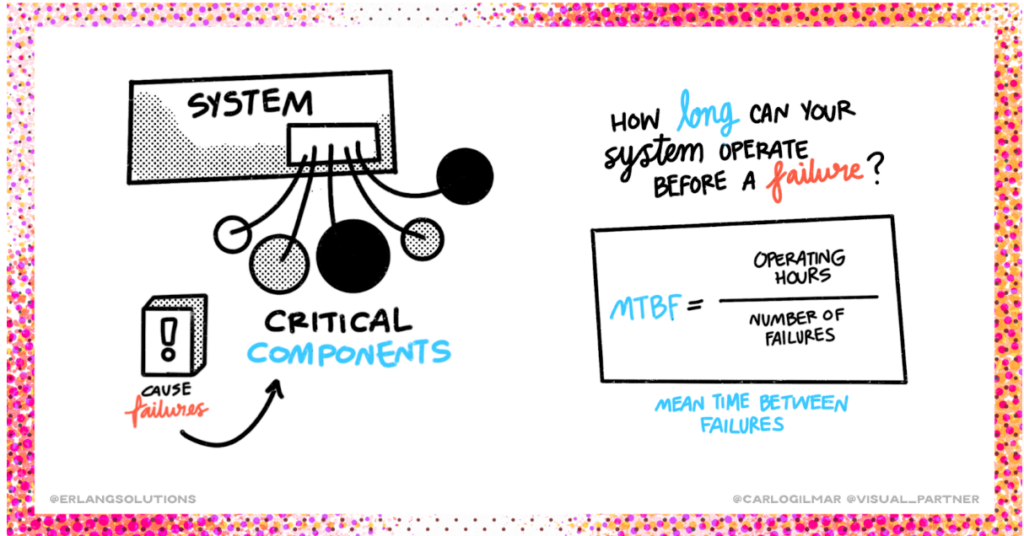
    For tandem systems , any system has critical components that could potentially cause failures. How often do you ask yourself how long can your system operate before a failure? There is a metric known as MTBF (mean time between failures), which is calculated by dividing the total operating hours of the system by the number of failures. The result represents the hours of uninterrupted operation.

    Many factors can affect the MTBF, including administration, configuration, maintenance, power outages, hardware failures, and more. So, how can you survive these eventualities to achieve at least virtual high availability in your systems?

    Tandem NonStop critical components

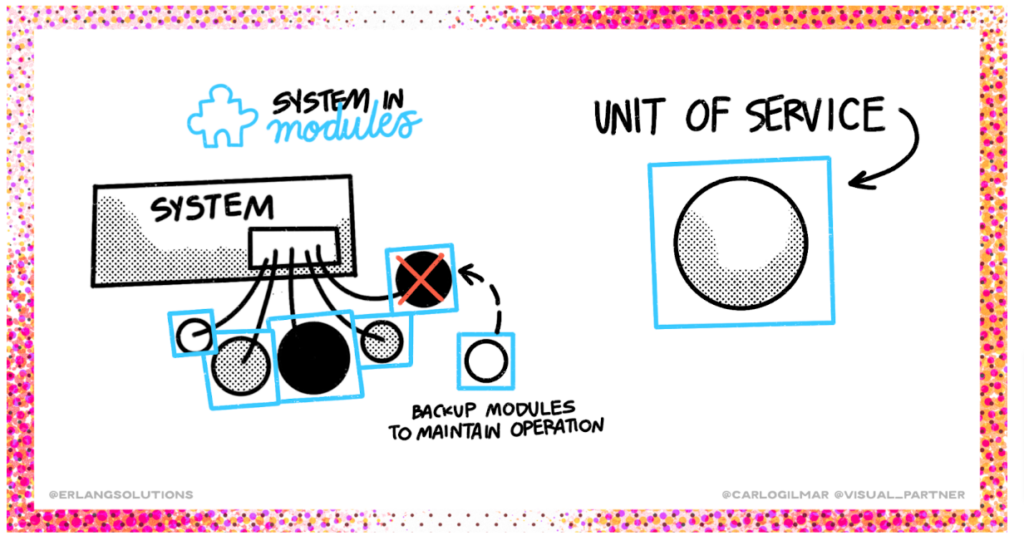
    High availability in hardware has taught us important insights about continuous operation. Some hardware implementations rely on decomposing the system into modules, allowing for modularity to contain failures and maintain operation through backup modules instead of breaking the whole system and needing to restart it. The main concept, from this point of view, is to use modules as units of failure and replacement.

    Tandem NonStop system in modules

    High Availability for Software Systems

    But what about the software’s high availability? Just as with hardware, we can find important lessons from operative system designers who decompose systems into modules as units of service. This approach provides a mechanism for having a unit of protection and fault containment.

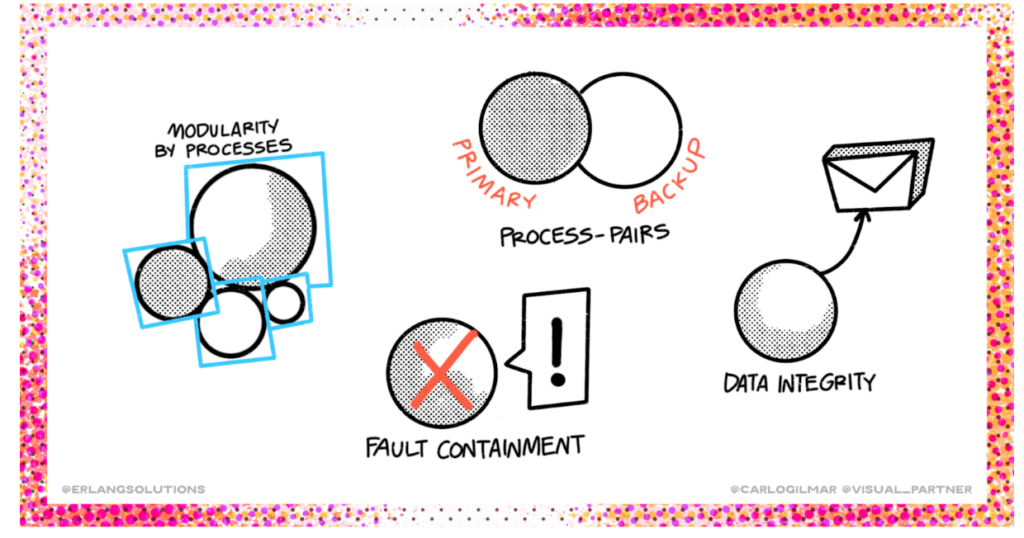
    To achieve fault tolerance in software, it’s important to address similar insights from the NonStop design:

    • Modularity through processes and messages.
    • Fault containment.
    • Process pairs for fault tolerance.
    • Data integrity.

    Can you recognise some similarities so far?

    The NonStop architecture essentially relies on these concepts. The key to high availability, as I mentioned before, is modularity as a unit of service failure and protection.

    A process should have a fail-fast mechanism, meaning it should be able to detect a failure during its operation, send a failure signal and then stop its operation. In this way, a system can achieve fault detection through fault containment and by sharing no state.

    Tandem NonStop primary backup

    Another important consideration for your system is how long it takes to recover from a failure. Jim Gray, software designer and researcher at Tandem Computers, in his paper ”Why computers stop and what can be done about it?” proposed a model of failure affected by two kinds of bugs: Bohrbugs, which cause critical failures during operation, and Heisenbugs, which are more soft and can persist in the system for years.

    Implementing Processes-Pairs Strategies

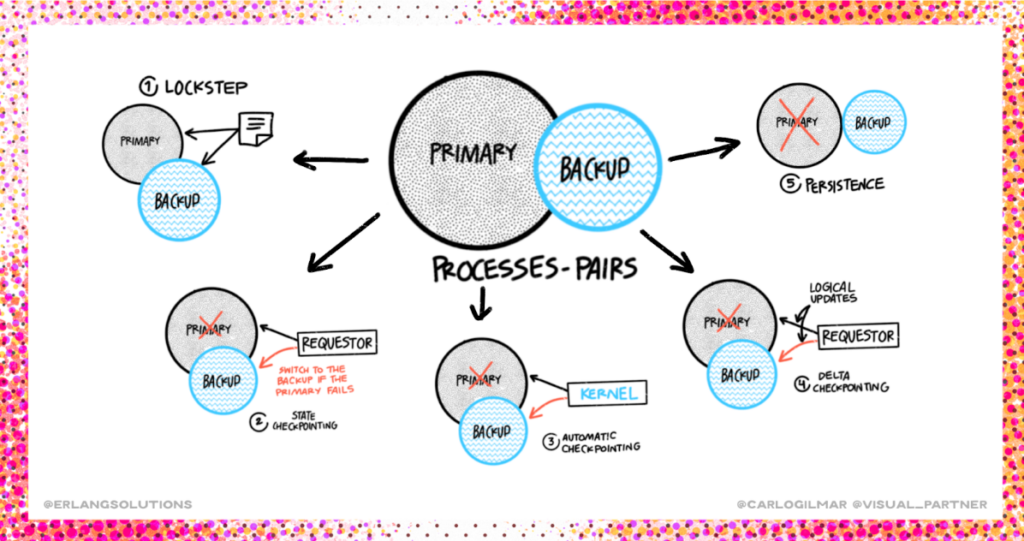
    The previous categorisation helps us to understand better strategies for implementing processes-pairs design, based on a primary process and a backup process:

    • Lockstep: Primary and backup processes execute the same task, so if the primary fails, the backup continues the execution. This is good for hardware failures, but in the presence of Heisenbugs, both processes will remain the failure.
    • State checkpointing: A requestor entity is connected to a processes-pair. When the primary process stops operation, the requestor switches to the backup process. You need to design the requestor logic.
    • Automatic checkpointing: Similar to the previous, but using the kernel to manage the checkpointing.
    • Delta checkpointing : Similar to state checkpointing but using logical rather than physical updates.
    • Persistence: When the primary process fails, the backup process starts its operation without a state. The system must implement a way to synchronise all the modules and avoid corrupt interaction.
    Tandem NonStop processes pairs

    All of these insights are drawn from Jim Gray’s paper, written in 1985 and referenced in Joe Armstrong’s 2003 thesis, “Making Reliable Distributed Systems in the presence of software errors” . Joe emphasised the importance of the Tandem NonStop system design as an inspiration for the OTP design principles.

    Elixir and High Availability

    So if you’re a software developer learning Elixir, you’ll probably be amazed by all the capabilities and great tooling available to build software systems. By leveraging frameworks like Phoenix and toolkits such as Ecto, you can build full-stack systems in Elixir. However, to fully harness the power of the Erlang virtual machine (BEAM) you must understand processes.

    Just as the Tandem computer system relied on transactions, fault containment and a fail-fast mechanism, Erlang achieves high availability through processes. Both systems consider it important to modularise systems into units of service and failure: processes.

    About the process

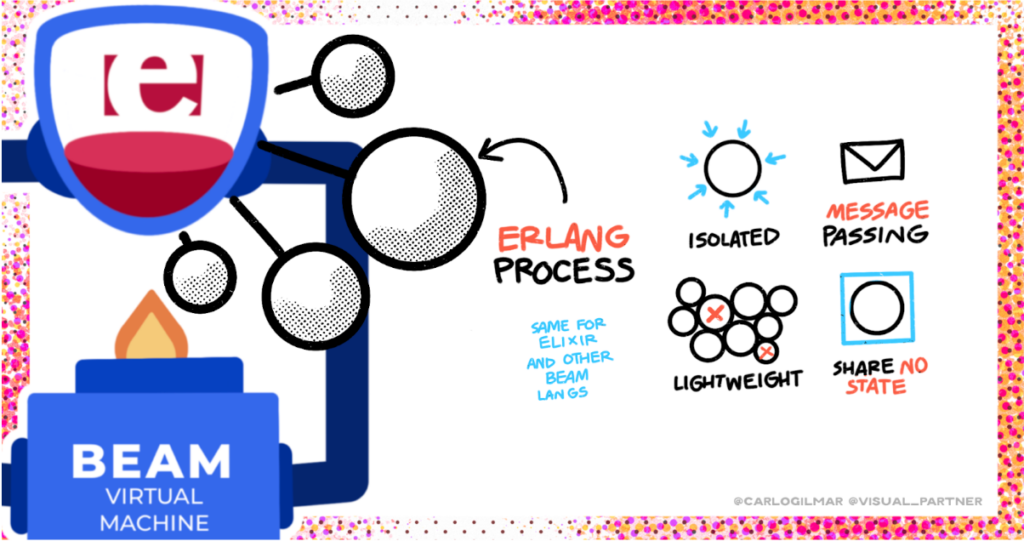
    A process is the basic unit of abstraction in Erlang, a crucial concept because the Erlang virtual machine (BEAM) operates around this. Elixir and Gleam share the same virtual machine, which is why this concept is important for the entire ecosystem.

    A process is:

    • A strongly isolated entity.
    • Creation and destruction is a lightweight operation.
    • Message passing is the only way to interact with processes.
    • Share no state.
    • Do what they are supposed to do or fail.

    Just remember, these are the fundamentals of Erlang, which is considered a message-oriented language, and its virtual machine (BEAM), on which Elixir runs.

    Tandem NonStop BEAM

    If you want to read more about processes in Elixir I recommend reading this article I wrote: Understanding Processes for Elixir Developers.

    I consider it important to read papers like Jim Gray’s article because they teach us the history behind implementations that attempt to solve problems. I find it interesting to read and share these insights with the community because it’s crucial to understand the context behind the tools we use. Recognising that implementations exist for a reason and have stories behind them is essential.

    You can find many similarities between Tandem and Erlang design principles:

    • Both aim to achieve high availability .
    • Isolation of operations is extremely important to contain failure.
    • Processes that share no state are crucial for building modular systems.
    • Process interactions are key to maintaining operation in the presence of errors. While Tandem computers implemented process-pairs design, Erlang implemented OTP patterns .

    To conclude

    Take some time to read about the Tandem computer design. It’s interesting because these features share significant similarities with OTP design principles for achieving high availability. Failure is something we need to deal with in any kind of system, and it’s important to be aware of the reasons and know what you can do to manage it and continue your operation. This is crucial for any software developer, but if you’re an Elixir developer, you’ll probably dive deeper into how processes work and how to start designing components with them and OTP.

    Thanks for reading about the Tandem NonStop system. If you like this kind of content, I’d appreciate it if you shared it with your community or teammates. You can visit this public repository on GitHub where I’m adding my graphic recordings and insights related to the Erlang ecosystem or contact the Erlang Solutions team to chat more about Erlang and Elixir.

    Tandem NonStop Joe Armstrong

    Illustrations by Visual Partner-Ship @visual_partner

    Jaguares, ESL Americas Office

    @carlogilmar

    The post Why do systems fail? Tandem NonStop system and fault tolerance appeared first on Erlang Solutions .

    • wifi_tethering open_in_new

      This post is public

      www.erlang-solutions.com /blog/why-do-systems-fail-tandem-nonstop-system-and-fault-tolerance/

    • chevron_right

      Ignite Realtime Blog: Openfire 4.9.0 release!

      news.movim.eu / PlanetJabber • 17 September, 2024 • 1 minute

    The Ignite Realtime community is happy to be able to announce the immediate availability of version 4.9.0 of Openfire , its cross-platform real-time collaboration server based on the XMPP protocol!

    As compared to the previous non-patch release, this one is a bit smaller. This mostly is a maintenance release, and includes some preparations (deprecations, mainly) for a future release.

    Highlights for this release:

    • A problem has been fixed that caused, under certain conditions, a client connection to be disconnected. This appears to have affected clients sending multi-byte character data more than others.
    • Community member Akbar Azimifar has provided a full Persian translation for Openfire!

    The list of changes that have gone into the Openfire 4.9.0 release has some more items though! Please review the change log for all of the details.

    Interested in getting started? You can download installers of Openfire here . Our documentation contains an upgrade guide that helps you update from an older version.

    The integrity of these artifacts can be checked with the following sha256sum values:

    7973cc2faef01cb2f03d3f2ec59aff9b2001d16b2755b4cc0da48cc92b74d18a  openfire-4.9.0-1.noarch.rpm
    a0cd627c629b00bb65b6080e06b8d13376ec0a4170fd27e863af0573e3b4f791  openfire_4.9.0_all.deb
    bf62c02b0efe1d37fc505f6942a9cf058975746453d6d0218007b75b908a5c3c  openfire_4_9_0.dmg
    1082d9864df897befa47230c251d91ec0780930900b2ab2768aaabd96d7b5dd9  openfire_4_9_0.exe
    12a4a5e5794ecb64a7da718646208390d0eb593c02a33a630f968eec6e5a93a0  openfire_4_9_0.tar.gz
    c86bdb1c6afd4e2e013c4909a980cbac088fc51401db6e9792d43e532963df72  openfire_4_9_0_x64.exe
    97efe5bfe8a7ab3ea73a01391af436096a040d202f3d06f599bc4af1cd7bccf0  openfire_4_9_0.zip
    

    We would love to hear from you! If you have any questions, please stop by our community forum or our live groupchat . We are always looking for volunteers interested in helping out with Openfire development!

    For other release announcements and news follow us on Mastodon or X

    1 post - 1 participant

    Read full topic

    • chevron_right

      Ignite Realtime Blog: Openfire Hazelcast plugin version 3.0.0

      news.movim.eu / PlanetJabber • 12 September, 2024

    Earlier today, we blogged about a boatload of Openfire plugins for which we made available maintenance releases.

    Apart from that, we’ve also made a more notable release: that of the Hazelcast plugin for Openfire.

    The Hazelcast plugin for Openfire adds clustering support to Openfire. It is based on the Hazelcast platform .

    This release brings a major upgrade of the platform. It migrates from version 3.12.5 to 5.3.7.

    As a result, replacing an older version of the plugin with this new release requires some careful planning. Notably, the configuration stored on-disk has changed (and is unlikely to be compatible between versions). Please refer to the readme of the plugin for details.

    A big thank you goes out to community member Arwen for making this upgrade happen!

    As usual, the new version of the plugin will become available in your Openfire server within the next few hours. Alternatively, you can download the plugin from its archive page .

    For other release announcements and news follow us on Mastodon or X

    1 post - 1 participant

    Read full topic

    • chevron_right

      Ignite Realtime Blog: Openfire plugin maintenance releases!

      news.movim.eu / PlanetJabber • 12 September, 2024

    The Ignite Realtime community is gearing up for a new release of Openfire. In preparation, we have been performing maintenance releases for many Openfire plugins.

    These Openfire plugin releases have mostly non-functional changes, intended to make the plugin compatible with the upcoming 4.9.0 release of Openfire:

    The following plugins have (also) seen minor functional upgrades:

    As usual, the new versions of the plugins should become available in your Openfire server within the next few hours. Alternatively, you can download the plugins from their archive pages, which are linked to above.

    For other release announcements and news follow us on Mastodon or X

    1 post - 1 participant

    Read full topic

    • chevron_right

      JMP: Newsletter: eSIM Adapter Launch!

      news.movim.eu / PlanetJabber • 11 September, 2024 • 2 minutes

    Hi everyone!

    Welcome to the latest edition of your pseudo-monthly JMP update!

    In case it’s been a while since you checked out JMP, here’s a refresher: JMP lets you send and receive text and picture messages (and calls) through a real phone number right from your computer, tablet, phone, or anything else that has a Jabber client.  Among other things, JMP has these features: Your phone number on every device; Multiple phone numbers, one app; Free as in Freedom; Share one number with multiple people.

    eSIM Adapter

    We’ve talked before about the eSIM Adapter , but today we’re excited to announce that we have a good amount of production stock, and you can order the eSIM adapter right now . Existing JMP customers who want to pay with their account balance can also order by contacting support . Have a look at the product launch on Product Hunt as well.

    JMP’s eSIM Adapter is a device that acts exactly like a SIM card and will work in any device that accepts a SIM card (phone, tablet, hotspot, USB modem), but the credentials it offers come from eSIMs provided by you. With the adapter, you can use eSIMs from any provider in any device, regardless of whether the device or OS support eSIM. It also means you can move all your eSIMs between devices easily and conveniently. It’s the best of both worlds: the convenience of downloading eSIMs along with the flexibility of moving them between devices and using them on any device.

    For JMP Data Plan Physical SIM Owners

    Our data plan has always had the choice for a physical SIM. For people who just want the data plan and no other eSIMs this works fine, and we will continue to sell these legacy cards until we run out of stock. However some of you might be wondering if you need to buy an eSIM Adapter now in order to get some of these benefits. The answer might be no! If you order just the USB reader, you can use the app to flash new eSIMs and switch profiles on your existing physical SIM! This isn’t quite as convenient as the full eSIM Adapter, you will need to pop out the SIM and put it into the USB reader even to switch profiles, but it does work for those who have one already.

    Cheogram Android

    Cheogram Android 2.15.3-3 and 2.15.3-4 have been released. These releases contain some improvements to the embedded “widget” system, funded by NLnet . You can now select from a large list of widgets right in the app. More improvements to this system are coming soon, and if you’re a web-tech developer who is interested in extending people’s chat clients, check out the docs !

    Email Gateway

    We sponsor the development of an email gateway, Cheogram SMTP, which is also getting better thanks to NLnet. The gateway now supports file attachments on emails, and will soon support sharing widgets with Delta Chat users as well!

    To learn what’s happening with JMP between newsletters, here are some ways you can find out:

    Thanks for reading and have a wonderful rest of your week!

    • wifi_tethering open_in_new

      This post is public

      blog.jmp.chat /b/september-newsletter-2024

    • chevron_right

      Erlang Solutions: How Generative AI is Transforming Healthcare

      news.movim.eu / PlanetJabber • 9 September, 2024 • 11 minutes

    Generative AI (Gen AI) has emerged as a transformative technology across the healthcare industry. It has the potential to vastly transform the clinical decision-making process and ultimately improve patient health outcomes.

    The adoption of generative AI is now valued at over $1.6 billion and the global AI market in the healthcare market is projected to reach $45.2 billion by 2026 .

    Given such rapid growth projections, healthcare providers should recognise the opportunities presented by generative AI and explore how to incorporate it to improve patient care.

    We will take an in-depth look into Gen AI and provide insights into how it is poised to revolutionise the healthcare space.

    Understanding Generative AI in healthcare

    So traditional vs generative AI- what’s the difference?

    Before we compare the two, let’s take a moment to clearly define them:

    Traditional AI- Also known as narrow or weak AI is a branch of artificial intelligence that executes tasks based on pre-established algorithms. These systems are usually specialised and excel at specific functions. However, they have a restricted range of applications compared to other types of AI.

    Examples include: Chatbots, voice assistants, credit score systems and spam filters.

    Generative AI- Is a form of artificial intelligence that can produce new outputs. These include text, images, and other types of data. It starts by analysing large amounts of existing data. Those insights are then used to create fresh content. Generative AI uses machine learning to identify patterns, make predictions, and generate new material based on the data it processes.

    Generative AI and predictive AI are quite similar, as predictive AI is also a learning-based technology that identifies and anticipates patterns.

    As well as data analysis, generative AI needs direct human input, or what is more commonly known as a “’prompt,’ to guide the AI’s output. Prompts aren’t just text focus. They also include videos, graphics, or audio.

    Key differences between Traditional and Generative AI

    Now let’s look into the main differences between traditional and generative AI:

    Aspect Traditional AI Generative AI
    Applications Is most commonly used for data analysis, forecasting, and optimisation tasks where rules are well-defined. Best for tasks such as image recognition, natural language processing (NLP), and sentiment analysis, where patterns in unstructured data are key.
    Data- handling Best for structured data and tasks requiring precise, rule-based decision-making. Best at managing and interpreting large volumes of unstructured data, such as images, videos, and text.
    Rules-based v learning-based Operates on explicit rules that are programmed by humans. Learns from data and adapts its behaviour according to the patterns it discovers.
    Flexibility and adaptability Rigid and less adaptable. It requires manual updates to handle new and/or unexpected situations. Highly flexible and capable of learning from diverse datasets. It can adjust to new scenarios without manual intervention.
    Creativity and autonomy Lacks creative abilities and autonomy and is confined to predefined rules and tasks. Highly capable of autonomously generating content, such as images and text, demonstrating creativity beyond rule-based systems.
    Learning capabilities Is dependent on predefined rules and algorithms and requires human intervention for updates or adjustments. It utilises deep learning to continuously improve by analysing data, identifying patterns, and making predictions, making it highly adaptable.

    While there are no clear “winners”, generative AI’s advantage lies in its broader offering. Its strength comes from using models to create unique content, without the need to rely on clear and rigid rules. Compared to its traditional counterpart, generative AI allows for greater flexibility and problem-solving.

    For healthcare industry leaders, the strategic value of Generative AI cannot be overstated. Its benefits provide the ability to foster a culture of continuous improvement, enabling organisations to innovate in a rapidly evolving industry.

    Enhancing patient care and outcomes with Generative AI

    Healthcare leaders have long understood the role of personalised care in meeting patient needs. Generative AI provides the opportunity to create personalised care plans, with the ability to leverage patient experience and achieve significantly better health outcomes.

    Here are some of generative AI’s main growing applications:

    Personalised treatment plans

    A standout advantage of generative AI in healthcare is its ability to create treatment plans that are uniquely tailored to each patient. Traditional approaches are dependent on standardised protocols, which might not fully address the specific needs of every individual.

    But generative AI can analyse extensive patient data- from medical history and genetic information to lifestyle choices and social factors- to develop highly personalised treatment recommendations.

    AI can examine a patient’s genetic likelihood of developing certain conditions and suggest preventative measures or specific treatment options. By offering customised care recommendations, healthcare professionals can enhance the effectiveness of treatments and reduce the chances of adverse effects, leading to improved health outcomes.

    Predictive analytics

    Generative AI also offers significant potential in the realm of predictive analytics, helping healthcare providers foresee and prevent potential health issues before they become critical. By examining large datasets of patient information, such as vital signs, lab results, and diagnostic images, AI algorithms can detect patterns that may signal future health risks.

    For example, researchers at Mayo Clinic utilised generative AI to develop a deep-learning algorithm to forecast the likelihood of patient complications following surgery.

    AD_4nXe8K32uUWWisMb7_z1AqKbQL8qMEFjnGCx9Iw_ArBqHAl30Gu02yA7-Xv-myNKzFXqjqHpoEiU71NiDERHVjC5HS2DwfUbBZdRb1BcarZGumo5JR2EiXpr_GBh6eKpmrf86dKuqo6rlf2EIifdtrrCsg-s?key=aVqbSaLi8JBihkoeHMBO7g

    It can produce customised treatment recommendations, depending on the risk.

    Enhanced diagnostic accuracy

    Diagnosis mistakes are a massive concern within healthcare. They can lead to incorrect or delayed treatment, which can lead to life-threatening consequences for patients. Generative AI provides enhanced accuracy of diagnoses by supporting healthcare professionals in their decision-making processes.

    Generative AI systems can:

    • Examine medical images, such as X-rays, MRIs, and pathology slides, with incredible precision.
    • Identify even the smallest abnormalities that might be missed by the human eye.
    • Recognise patterns that are linked to particular diseases by learning from sizable datasets.
    • Analyse symptoms and clinical data to suggest possible diagnoses.

    By improving diagnostic accuracy, generative AI helps to ensure timely and correct treatments. It also reduces the likelihood of unnecessary procedures and time delays, which ultimately ease the strain on healthcare systems.

    Virtual health assistants

    Chatbots that are powered by AI act as virtual health assistants (VHAs) for patients. They can provide a wealth of information, such as answering medical queries, providing relevant health information, medication reminders, personalised health advice and necessary support for chronic conditions- to name a few services.

    DAX Express , a notable US healthcare provider integrates GPT-4, a generative AI technology, to automate clinical documentation. This application listens to patient-physician interactions and then generates medical notes. The notes are directly uploaded into Electronic Health Records (EHR) systems, removing the need for a human review.

    AD_4nXeHJQtnPUoldUvSfOq6ujll8gPR5BDdu_urQCCpnrmfd0XnWx5HoZQcfkiMV5TkFRR2Lj7qAr3h5g4HrbJLjlDPJPO3aZafgV7ekC7rnAydloXFrGexEQfjryabYhXfCcg_ct-hlszXTqFPGzfs2VwTI7Aa?key=aVqbSaLi8JBihkoeHMBO7g

    The use of gen AI in DAX Express significantly speeds up the documentation process. It reduces it from hours to seconds, a substantial benefit of VHAs. This also improves patient care by allowing doctors more time with patients, enhancing the accuracy of medical records, and speeding up follow-up treatments.

    Operational efficiency and cost reduction

    As briefly mentioned, AI’s ability to provide transformative solutions that streamline processes and reduce costs, while enhancing patient care is a major driver for healthcare service providers  Various AI-driven technologies including GenAI are reshaping the way healthcare organisations operate, so both providers and patients benefit from these advancements.

    Wearables to enhance patient monitoring

    Fitbits, Apple watches, Oura rings and ECG machines are just a few examples of AI-powered wearables that are transforming patient care through continuous health monitoring.

    According to research by Deloitte, wearable technologies are expected to reduce 16% of hospital costs by 2027, and by 2037, it could save $200 billion with its remote patient monitoring devices. These devices are designed to catch potential health issues early, reducing the need for emergency interventions and, therefore lowering the frequency of hospital visits. They also empower patients to manage their health proactively, thanks to personalised reminders, which are aimed to foster healthier habits (think of fitness rings on your Apple watch).

    This approach optimises healthcare resources and contributes to reducing overall healthcare costs.

    Accelerating drug discovery and reducing costs

    In the pharmaceutical sector, generative AI is accelerating drug discovery processes for faster treatment development, especially in underserved medical areas.

    Gen AI models analyse large amounts of data to identify new disease markers, streamlining clinical trials and reducing their duration by up to two years.

    Improved accessibility and inclusivity

    AI-driven chatbots and digital assistants are breaking down barriers to healthcare access. They support multiple languages and provide user-friendly interactions.

    These tools make healthcare more inclusive, especially for patients with disabilities or those who face language barriers. By ensuring that everyone can access care without obstacles, AI enhances patient satisfaction and promotes equity in healthcare delivery.

    Optimising data management and analysis

    The healthcare industry generates vast amounts of data daily, and managing this information efficiently is crucial. Traditional AI assists in organising and analysing healthcare data, which helps professionals extract valuable insights quickly.

    Generative AI can sift through electronic health records, research articles, and clinical notes to identify patterns and trends, enabling more informed decision-making and improving the overall quality of care.

    Enhancing supply chain and equipment utilisation

    AI is also playing a critical role in optimising the healthcare supply chain and equipment usage. According to research from Accenture , 43% of all working hours across end-to-end supply chain activities could be impacted by gen AI in the near future.

    AI algorithms can provide actionable insights into the best supplies or drugs to use, considering cost, quality, and patient outcomes. Additionally, gen AI helps schedule diagnostic equipment, ensuring that costly machines like MRIs and CT scanners are utilised to their full potential. This not only reduces operational costs but also enhances the overall efficiency of healthcare delivery.

    Integrating Elixir in Generative AI in Healthcare

    As healthcare organisations increasingly adopt generative AI technologies, integrating the right tools and technologies is crucial for maximising their potential. Elixir , a functional and concurrent programming language is well-suited to underpin the delivery of AI models, due to its scalability, performance and ability to handle large-scale data processing efficiently. Healthcare organisations can leverage Elixir to ensure robust, reliable deployment of their generative AI technologies, to drive innovation and enhance capabilities.

    Let’s look into some of the key features of Elixir:

    • Concurrency: Elixir excels at managing numerous simultaneous tasks, crucial for handling the large-scale data processing needs of AI applications.
    • Fault tolerance: Built to handle failures with ease, Elixir ensures continuous operation and reliability—a key trait for healthcare systems that demand high uptime.

    Scalability: Elixir’s ability to scale horizontally supports the growing computational demands of advanced AI models and data analytics.

    Improved data processing and management

    Elixir’s concurrency capabilities allow for efficient handling of multiple data requests. This feature is essential for real-time AI applications in healthcare, for example, diagnostic tools and patient management systems. Its scalability allows healthcare organisations to build robust data pipelines, ensuring smooth data flow and faster processing.

    Enhanced system reliability

    Elixir supports fault-tolerant architectures. It maintains system reliability for critical healthcare applications. Its ability to recover from errors without system-wide disruption means that AI-driven healthcare solutions remain operational and dependable.

    Optimised performance

    Once again, Elixir’s scalability meets the growing demands of AI workloads. This improves computational efficiency and enhances overall system performance. Its support for real-time processing also improves the responsiveness of healthcare applications, providing immediate feedback and improving operational efficiency.

    Integrating Elixir and other technologies with generative AI provides huge potential to enhance healthcare applications- from improving data management to optimising system performance. For business leaders, strategic planning and collaboration are key to harnessing these technologies effectively, to ensure that their organisations can capitalise on the benefits of AI while maintaining robust and reliable systems.

    The future of Generative AI

    While generative AI has the proven power to revolutionise the healthcare industry, some ethical and regulatory points still need to be considered. Areas surrounding patient privacy, security and equitable access to AI-powered equipment are still a work in progress.

    Consumer trust is also a critical factor in the future of AI. To optimise AI results, business leaders need to understand consumers’ feelings towards Generative AI.

    In a survey conducted by Wolters Kluwer, while those asked did have some concerns or fears surrounding generative AI, 45% were “starting from a position of curiosity.” Over half (52%) of those surveyed further reported that they would be fine with their healthcare providers using gen AI to support their care.

    generative ai in healthcare american feelings

    The trust in gen AI is not just down to the technology, but the trust of the consumer in their healthcare provider.

    As these issues are addressed, a new era of improved health outcomes and more accessible medical services is just years, if not months, away from being a reality.

    To conclude

    AI has undeniable transformative potential. Leveraging and gaining a better understanding of this technology is key to embracing innovation in the healthcare industry and most importantly, prioritising patient-centric care.

    Whether your current systems are falling short or you’re actively seeking new ways to improve patient outcomes and operational efficiency, generative AI provides a powerful solution. It can revolutionise how healthcare services are delivered- from personalised treatment plans to predictive analytics and enhanced diagnostics.

    By adopting gen AI, you can position healthcare providers at the forefront of healthcare innovation. If you’d like to talk more about your healthcare needs or how Elixir can power your AI model, feel free to drop us a line .

    The post How Generative AI is Transforming Healthcare appeared first on Erlang Solutions .

    • wifi_tethering open_in_new

      This post is public

      www.erlang-solutions.com /blog/how-generative-ai-is-transforming-healthcare/

    • chevron_right

      Erlang Solutions: Erlang Solutions announces latest business win with Razoyo to meet growing demand

      news.movim.eu / PlanetJabber • 6 September, 2024 • 1 minute

    Erlang Solutions , a global technology and consultancy service provider, is pleased to announce its latest customer win with Razoyo , a leading e-commerce consultancy and software development agency.

    Razoyo needed urgent support and additional team members to handle sudden increased demand and extra client needs. They appointed Erlang Solutions for their expertise and ability to provide the right specialists fast, ensuring Razoyo meets their quick turnaround.

    Commenting on the latest partnership, Mark Cowan, International Business Development Manager at Erlang Solutions said: ” We are excited to support our newest client Razoyo with our expert team and specialist resources. We look forward to working with them to deliver continued outstanding service.”

    Paul Byrne, President at Razoyo, added “When faced with such high demand, outsourcing was key for us to manage this peak time in the business. Erlang Solutions stepped in swiftly with their expertise to meet our needs. We look forward to working with them to maintain our high standards of delivery.”

    Razoyo is an award-winning eCommerce and Development Agency serving the needs of medium and large-size businesses. They work with thousands of merchants each year to improve and expand their business.

    With 26 years of expertise, Erlang Solutions is renowned for its world-leading consultants in Erlang, Elixir, and beyond. The company delivers efficient and reliable system solutions for some of the world’s most ambitious companies.

    The post Erlang Solutions announces latest business win with Razoyo to meet growing demand appeared first on Erlang Solutions .

    • wifi_tethering open_in_new

      This post is public

      www.erlang-solutions.com /blog/erlang-solutions-announces-latest-business-win-with-razoyo-to-meet-growing-demand/